Welcome

Monday, 5 January 2015

Start the new year with a trip to the US

With the most important Chinese holiday approaching in February, many Chinese have begun signing up for travel to the United States, adding to a major source of US tourism.

Chinese and US travel agents are monitoring the burgeoning market of middle-class Chinese families making trips during an otherwise slow winter season for US tourism.

The California Travel and Tourism Commission, the state's official travel promoter, and four Chinese tourism companies have launched a project to attract Spring Festival vacationers from China.

The bigger objective is to make California the top destination for Chinese travelers during Spring Festival, said commission president Caroline Beteta.

The Chinese Lunar New Year, or Spring Festival, begins on Feb 10 this year and lasts a week — though it can be stretched beyond two weeks when combined with the Lantern Festival, which begins on Feb 24.

Helen Tsui, director of Asia-Pacific tourism for the San Francisco Travel Association, said China is an important and growing market for the city.

"We are one of the first destinations that established representation offices in Shanghai and Beijing more than 15 years ago," she said.

"Since last year, our Shanghai office has also been working with five leading outbound tour operators in Shanghai to launch the Western America tour package targeting the Chinese New Year holiday," she said.

Preliminary figures show that Chinese citizens made more than 80 million trips to other countries in 2012, Dai Bin, president of the China Tourism Academy, said on Thursday.

Li Zhi, a 31-year-old engineer from Beijing, got tired of the huge crowds lining up at this time of the year in Chinese cities to buy train tickets to their hometowns.

He found he could beat the February travel rush and stay within his travel budget by taking a 12-day trip to the US.

"I'll pay for my parents' travel expenses and have a special Spring Festival with them in the United States this year," Li said.

Generous holiday spending indicates to friends and family that one is on good financial footing. "Not to mention spending the holiday in the US is very cool and worth showing off!" he exclaimed.

Meanwhile, Chinese consumers also prefer more high-end tourism products in the US, some business insiders said.

"The middle and high-end tourism routes to the US are our main products in the festival this year," said Zhang Qingzhu, marketing manager of China Comfort Travel Group.

Zhang said the agency launches products like golf and island tours in the US according to consumer demands.

"The number of our customers going to the US during the festival increased by about 15 percent over the last festival," she added.

Zhang Huiling, deputy manager of the American travel department at China CYTS Tours, said her company designed two itineraries for Chinese visitors — a 12-day West Coast trip or a 15-day tour across the US.

Prices range between 24,800 yuan ($4,000) and 31,800 yuan depending on departure times and airline, Zhang Huiling said.

This year's West Coast route includes three national parks: The Grand Canyon in Arizona, and Bryce Canyon and Zion in Utah. Two days' accommodation for Disneyland in Anaheim, California, is another selling point.

Wang Qian, head of American travel at CITS Ltd, said a trip to the US during Spring Festival is cheaper than in the peak July-September season.

Sarah Roach, tourism manager at Bloomingdale's department store in San Francisco, said she expects Chinese travelers will do plenty of shopping during their holiday sojourn. She said Bloomingdale's will have a number of special promotions for Spring Festival, with events throughout the store including traditional lion dancers, musicians, art exhibits, tea and dim sum tasting, and celebrity chefs.

The San Francisco store has more than 40 sales clerks who speak Mandarin and Cantonese, she said.

In New York, Mayor Michael Bloomberg announced recently that the city welcomed an estimated 41 million US visitors and 11 million international visitors in 2012. Helping drive the upward trend are tourists from China, whose numbers have increased more than fivefold since 2006, according to NYC & Co, the city's official tourism promotion arm.

Source: By Chen Jia in San Francisco and Wang Wen in Beijing (China Daily)

Chinese Tourists Lost in Thailand Mean Record Hotel Stays


“Lost in Thailand,” a low-budget Chinese comedy about the travels of two rival businessmen and a pancake-maker through Thailand, may help the Southeast Asian nation attract a record number of tourists this year.

More than 30 million people have seen the film since its debut on Dec. 12, according to China’s official Xinhua News Agency. China overtook Malaysia last year as Thailand’s biggest source of overseas tourists, and the film’s popularity could help increase total arrivals by 10 percent in 2013, according to the Association of Thai Travel Agents.

“The movie is helping boost sentiment and is increasing people’s desire to visit,” Sisdivachr Cheewarattanaporn, the group’s president, said yesterday in an interview. “The global economic situation isn’t a big issue as we’ve seen the tourism industry grow a lot despite the slowdown. People who love traveling continue to do it anyway.”

Thailand is luring Chinese tourists away from Japan after a territorial dispute between Asia’s biggest economies led to a travel boycott last year. Hotel rates in Bangkok also remain about half those in Singapore and Hong Kong, while the baht’s gain in the past year has been overshadowed by bigger increases in the value of the Singapore dollar and the Philippine peso.

“Foreign tourists are flocking back to Thailand,” said Sittidath Prasertrungruang, an analyst at Krungsri Securities Co. “The Thai tourism industry is very resilient, with diversified sources of travelers from China and India to Russia,” he said, adding that travel-related stocks will outperform the benchmark SET Index (SET) this year.

Floods, Protests

Thailand’s tourism industry has recovered from floods that swamped the ancient capital of Ayutthaya in 2011, echoing similar revivals after the 2004 Indian Ocean tsunami that devastated beach resorts and political protests that shut the main airport for two weeks in 2008 and turned inner Bangkok into a war zone in 2010.

“The tourism sector will remain strong this year,” Jaroonpan Wattanawong, an analyst at Maybank Kim Eng Securities (Thailand) Pcl said by phone. More than 22 million overseas tourists may visit Thailand, while a reduction in personal income taxes will help boost domestic travel, he said.

Jaroonpan has a buy recommendation on Airports of Thailand with a price target of 102 baht, and also favors Asia Aviation Pcl (AAV), the parent of Thai AirAsia Co. (AIRA) Asia Aviation shares rose 5.6 percent to 5.65 baht, the highest close since the company’s initial public offering in May last year.

‘Big Growth’

China accounted for 13 percent of the 19.8 million visitors to Thailand in the first 11 months of last year, according to tourism ministry data. The Tourism Authority of Thailand forecasts total visitors may rise to 24.5 million this year, from an estimate of more than 21 million in 2012.

“China is really just blowing everyone out of the water,” said William Heinecke, Minor’s chief executive officer. “In percentage terms, numbers from Europe and the U.K. are down. In actual numbers, they’re still the same or slightly higher. But the big growth is coming from Russia and China.”

Thailand’s existing airports may struggle to accommodate the increased number of tourists, said Sittidath of Krungsri Securities. Minor’s Heinecke said the government’s decision to build an additional terminal in Phuket and move some operations to Don Mueang, Bangkok’s former international airport, will help ease congestion.

“Thailand has generally always been very strong with its infrastructure, whether you’re talking about mass transit or highways or airports,” said Heinecke, who owns hotels managed by Four Seasons Hotels Inc. and Marriott International Inc. in Thailand as well as his own Anantara-brand resorts. “They’ve generally been ahead of the curve, much like China.”

$200 Hotels

Chinese tour groups added additional charter flights to Thailand as demand for travel to Japan declined because of the territorial dispute between the two countries, said Sisdivachr from the Association of Thai Travel Agents. Heinecke said Thailand’s reputation as an inexpensive holiday destination is also luring more tourists from Southeast Asia.

“If you’re going to cut back you’re probably going to cut back on a trip to Singapore or Hong Kong where you’re going to pay $400 a night for a luxury hotel versus $200 a night in Thailand,” Heinecke said.

The success of “Lost in Thailand,” which is the first Chinese movie to make more than 1 billion yuan ($160 million) in box-office receipts, according to Xinhua, may convince even more Chinese to choose Thailand, Sisdivachr said.

The Chinese film follows the Hollywood blockbuster “The Hangover: Part II” from 2011, which was set in Bangkok and the coastal province of Krabi. The movie went on to gross $581.5 million in worldwide receipts, according to Box Office Mojo.

“The tourist numbers are continuing to pop,” said Minor’s Heinecke. “We’re seeing it in Phuket, we’re seeing it in Samui, we’re seeing it all over the country.”

Source: Bloomberg News By Suttinee Yuvejwattana & Supunnabul Suwannakij

Snow-covered West Lake


Photo taken on Jan. 4, 2013 shows the snow-covered landscape of West Lake in Hangzhou, Zhejiang Province. Citizens and tourists enjoyed the snow-covered landscape of West Lake here on Friday after northern and central Zhejiang received continuous snowfall since this Thursday. (Xinhua)

Sunday, 4 January 2015

Life by Erhai Lake


Shuanglang is a small tranquil fishing village located on the banks of Erhai Lake in Dali in southwestern China's Yunnan Province. Surrounded by low mountain ranges and facing the velvety water of Erhai Lake, the village has become an emerging tourist site.


Using cormorants to catch fish on Erhai Lake was once a prosperous tradition in Shuanglang. But today only a few still keep the practice alive.


An array of houses lines the banks of Erhai Lake.


Fishing boats are anchored along the shores of Erhai Lake.


Dali's gate tower is illuminated at night.

Source:CRI

Beihai Park in Winter


While people cram for space on neighboring lake Houhai, a quieter Beijing winter scene plays out in Beihai Park. The imperial garden may be littered with historical sites, but when winter rolls around it's obvious that the ice of Beihai Lake becomes the main attraction.

Five separate sections of ice are spread out across the 35-hectare lake, which include areas specifically for activities like sliding around on ice chairs, sprinting on ice bikes, skating, and even driving ice bumper cars.

The main section is by the park's southern gate, where there's space for every activity. A set of speakers play Chinese pop songs out to the buzzing congregation on the ice. The minus ten degree temperatures have failed miserably to keep the crowds indoors.

Skate rentals are popular, but the area designated for skating is surprisingly small, less than half the size of a professional hockey rink. Those on the ice don't seem to mind, however as quite a few of them unsteadily teeter along.

"At Beihai most people don't know how to skate well," noted the man who was helping out with some young hockey players. It's true that Beihai seems to cater to novices, and show-offs are hardly to be found.

"I've never skated at Houhai, so I don't know how it is there," admitted Dai, a young man visiting with his girlfriend, "but his is my second time skating here at Beihai."

"Our friends recommended we come here," said Yingying, a visitor from Shenzhen, before adding, "People from outside of Beijing know more about Beihai than Houhai."

Beihai's busiest section of ice is the south gate multi-use space, next to the skating section. Chairs modified
to slide on the ice as propelled by handheld poles are surprisingly popular, though the ice bikes are clearly more exciting to ride. They weave through the ice chairs, occasionally tipping over from attempting too-tight turns.

The ice bikes may be fast, but could they match the thrills of the ice bumper cars? Probably. The battery-powered bumper cars make their impact based on novelty as opposed to thrills. Nonetheless, Wang Di really enjoyed driving the car. "It's winter so there isn't so much other fun to have in Beijing. I like the happy environment here." After lifting his daughter out of the inflated rubber tube , he admitted that the car was pretty slow for adults. "Safety comes first in Beijing," he laughed.

Closer to the north gate are two more areas of ice, one specifically for ice chairs, and one is a long strip of ice for ice bikes to charge up and down on. But these sheets of ice tend to be quieter, both literally and in terms of numbers. There's no music broadcast, and the feeling definitely leans more towards peaceful here.

Bordered in by bars at all sides, Houhai Lake may be where the party is at, but when their skates are all rented out, or if you prefer a less crowded place to embarrass yourself after lacing up skates for the first time, then Beihai Park is the obvious alternative. Also, any Beijinger knows that the historical importance of Beihai Park may perhaps only be seconded by its beauty. Even in winter.

Getting to Beihai Park:

Take subway line 6 to Beihai North.
Ice hours: 09:00 – 16:30
Park entrance: 5 yuan (off-peak season)
Ice area entrance including various rentals: 30 yuan and up, plus deposits (100 yuan or 200 yuan for bikes).
Ice area entrance with no rental: 10 yuan.
Source: CRI by William Wang

Free WiFi Planned for Guangzhou Metro

(CRI) The southern Chinese city of Guangzhou may soon become the third city on the Chinese mainland to offer free WiFi services to subway riders.

Southern Galaxy Valley, a WiFi solutions provider based in the nearby city of Shenzhen, has co-founded a joint venture with Guangzhou Metro to operate the city's subway WiFi services, according to Southern Metropolis Daily, citing Zhou Fazhan, chairman of Southern Galaxy Valley.

Zhou says that construction is set to begin after the upcoming Chinese New Year in February. The plan is to launch free WiFi services for selected subway lines in July, 2015, and cover all subway lines in 2016.

Southern Galaxy Valley operates about 70 percent of all subway WiFi services on the mainland. The services are available only in a few cities including Shenzhen and Shanghai.

A big challenge in introducing wireless coverage to the subway is that a WiFi signal shares the same 2.4 GHz band with the Communications-Based Train Control (CBTC) signaling system. Many metro systems use the CBTC system to manage traffic and ensure safety.

This band-sharing problem reportedly caused one subway line in Shenzhen to suspend service for a while in November, 2012.

For the new services in Guangzhou, Southern Galaxy Valley has managed to work out a solution that will prevent WiFi signals from disturbing the CBTC system.

The entire project is expected to cost 200 million yuan (US$32.3 million).

Guangzhou has one of China's busiest metro networks. It saw about 6.22 million daily rides this year, according to Southern Metropolis Daily.

Source: CRI

Saturday, 3 January 2015

Traditions and celebrations

There are a thousand ways to celebrate Spring Festival or Lunar New Year because of the vastness of the country. We track from north to south and from east to west to give you four different ways.

Harbin in Northeast China offers you the coldest ice sculptures and frozen pears with the hottest yangko dance and dumplings. Sanya in South China brings the warmest tropical wind and bluest ocean.

In Hunan's Fenghuang ancient town, the starlight-like river lanterns lead you into the most poetic scene. At Shanxi's Qikou township, the roaring Yellow River, accompanied by the cracking of ice, thrills you with the best of nature.

Harbin, Heilongjiang

Dubbed "Paris of the Orient", Harbin carries the post-Christmas joy right up to Lunar New Year.

The provincial capital of Heilongjiang province in Northeast China still maintains some traces of Western lifestyle and more than 200 fine examples of Russian architecture in town.

But come Spring Festival, the city blends Eastern and Western elements to perfection. The highlight is the annual Harbin Ice and Snow Festival, bringing with it ice sculptures, on-ice performances and entertainment galore.

From Lunar New Year's eve right up to the 15th day of the first month in lunar calendar, every family has a red lantern in their home. Locals and visitors are treated to the yangko dance, a form of folk dance popular in northern China. The dance is so contagious that tourists are not expected to remain observers for long, but to join the dancers and have a good time.

Like most Chinese, local Harbin residents pay special attention to family reunion dinner on the eve of Lunar New Year. The meal must include the "big four" - chicken, fish, ribs and pork leg. If any of the "big four" is missing, it is not considered a reunion dinner with Northeast flavor.

And of course, dumpling is the most important food on the dinner table. The filling can range from sauerkraut to pork, shallot and lamb, and tomato and egg.

Making dumplings with family members is the best bonding activity, and the fastest way for new friends to warm up. Some families will also put a few coins into some of the dumplings. There is a belief that those who chance upon the "fortune dumplings" will be blessed with good luck throughout the coming year.

After a sumptuous dinner, sink your teeth into a frozen pear - a genius creation that can only be inspired by a temperature of -30 C.

Sanya, Hainan

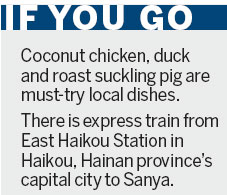
If you are not coping with the cold in North China very well, you will love Sanya in South China. Celebrating Lunar New Year in the tropics is equally exciting.

Nature has blessed Sanya with the best weather, the freshest air, the sunniest sunshine, the bluest ocean and the most delicious seafood. Staying in the island makes you forget about time.

Yalong Bay is a half-moon-shaped bay of 7.5 km in Southeast Sanya. Sand here is soft and glitters under the sun, while the sea is blue and as clear as crystal, with an average temperature of 25 C, making it an ideal year-round swimming paradise.

You may also consider having your wedding portraits done in Sanya. With the breathtaking scenery, you are guaranteed the best and most memorable photographs.

Fenghuang, Hunan

With a name that means "phoenix", you can be assured of a remarkable Spring Festival celebration in this ancient small town in western Hunan province.

The locals keep to the traditional way of celebrating the Lunar New Year. Before reunion dinner, they will have a ceremony to worship their ancestors and after dinner, the older generations in the family will distribute hongbao or red envelops with money to children. And everyone stays up until the wee hours of the morning to usher in the New Year.

Fenghuang cuisine is mainly hot and sour, which makes you perspire as you savor the dishes. The names of the dishes, such as potted mushrooms and sour soup tofu, are enough to make you salivate.

Customs like making sausages and sweet wine, and shopping on the New Year Miao ethnic market remain very much alive.

The most interesting tradition is to float the river lantern. People gather on the Tuojiang River, put the paper-made lanterns on the water surface, light the candles and let the river takes the lanterns and the wishes of the people to wherever it flows. At midnight of New Year's eve, the local government will let off large-scale fireworks, which last for 40 minutes and are really a feast for the eyes.

From the first day to the 15th day of the Lunar New Year, there are also all kinds of performances and galas from various organizations and villages on Phoenix Congwen Square.

Qikou, Shanxi

The Qikou township is a remote town along the Yellow River in Shanxi's Linxian county. Its location at the boundary of Shanxi and Shaanxi provinces gives it the rich culture and characteristics of both the places.

At Qikou, you can watch the ice floating along the Yellow River during the Spring Festival. The Yellow River looks like a huge snake that is casting off its skin. The ice cracks and rumbles like a rock concert on the river.

You can hide in one corner and daydream, or you can sit on heated adobe bed and learn to make cloth tiger and paper-cut decorations from local villagers.

Source: By Zhang Zixuan (China Daily)