Welcome

Showing posts with label Yunnan Province. Show all posts

Sunday, 29 November 2015

Along the Tea Horse Road in China’s Yunnan Province

On the dashboard of our van, a solar-powered Tibetan prayer wheel spins continuously as we make our way through the bumpy roads linking Lijiang, Dali and Tengchong.

After our fourth or fifth near-collision, I begin to stare at that miniature golden cylinder. Maybe a little Buddhist intervention will save us from crashing into a truck laden with giant boulders or plunging off the road into the canyons below.

We had come to see the northwest part of Yunnan, bordering Myanmar and Tibet, an ancient landscape that is rapidly changing. With the countless shops in fake-historic Lijiang selling identical Yunnan handicrafts, along with the rowdy backpacker scene in Dali, sections of Yunnan are being lost to the kind of tourism that involves busloads of passengers wearing matching baseball caps.

Lijiang, “restored” in the ancient style after a 1996 earthquake, was exactly the sort of place we wanted to avoid. Having lived in China for almost two years, we had already seen “Impression West Lake,” Zhang Yimou’s over-the-top evening extravaganza in Hangzhou, so there was no need to take in “Impression Lijiang,” set against the backdrop of Jade Dragon Snow Mountain. And if we wanted to fight crowds like those on the cable car up the mountain, we could stay home in Beijing and wander through the Forbidden City on a hot summer day.

Shaxi, located roughly halfway between Lijiang and Dali, turned out to be the perfect antidote. It feels as removed from the modern world as Lijiang—where you can find McDonald’s, Pizza Hut and KFC—is immersed in it. A stop on the so-called tea-horse road (sometimes called the Southern Silk Road) for centuries, Shaxi today is placid and friendly, its quiet disturbed only by the occasional pigs or turkeys wandering through the cobblestone town square.

Walking around, we could imagine what it was like to be among the traders of old. The roads linked China to Tibet, Myanmar and other parts of Southeast Asia, bringing Yunnan’s tea to the world in a network that “vastly predates the modern world,” says Ed Jocelyn, founder of Red Rock Trek, a tour-guide company based in Dali.

We were far from the first foreigners to trek these parts. The Austrian-American explorer Joseph Rock lived near Lijiang from the 1920s to 1940s and cataloged the area’s people, plants and languages with a thoroughness that hasn’t been upstaged since.

His Yunnan was a far rougher place, with bandits attacking caravans and yak-butter-greased rope slides being used to ferry both people and terrified horses across raging rivers. At one point he describes a village as “charmingly situated, if not overclean.”

In Shaxi, we stayed in Laomadian Lodge, a restored inn once used by tea and horse traders, and it was easy to envision them trudging up the narrow wooden stairs and resting inside the low-ceiling rooms. Today, the inn features slate-floored bathrooms and other modern updates. In the evening, a handful of tourists walked around the town square, which includes a Buddhist temple and a restored theater that now houses a trading-route museum.

Fueled by a surprisingly good cappuccino from the nearby Old Tree Café (now that’s modernization I can get behind), we met our guide, Frank Hitman, for a hike to the base of a mountain called Shibaoshan, or Stone Treasure Mountain. This region of China is famed for its biodiversity, a contrast to Beijing, where we make do with tightly landscaped parks and a few sad birds. Unesco says that the area known as “Three Parallel Rivers”—the Yangtze, Nu and Mekong—may harbor “the richest biodiversity among the temperate areas of the world,” with 6,000 species of plants and endangered species such as the red panda.

As the heat, elevation and birdcalls increased, I started to think of the hike as a Buddhist boot camp. Maybe true awakening comes through sweat.

A few hours later we were rewarded with the sight of the Shizhong temple, which includes 16 grottoes carved in the reddish rock that date back to the eighth century. Yunnan’s ethnic diversity and links to the outside world have meant that the province is home to several forms of Buddhism, Confucianism, animist religions such as Dongba, and other faiths.

More than one statue can be seen in the grottoes at Shizhong, including a layman, Vimalakirti, whose worried facial expression stands out in contrast to the serene Buddhist visages.

It’s possible he was worried about what we saw next: something called the Yoni Shrine, a miniature grotto with a carving that may or may not be connected to worship of female reproduction. A tourist from Guangzhou began telling us about the other intimate body parts he’s seen represented on his travels, and our faces started to take on the look of Vimalakirti as we inched away.

The Buddhist boot camp continued with a post lunch hike to Baoxiang, another mountaintop temple. Mist rising from a nearby waterfall cooled us as well as a colony of macaques, who eyed us for snack potential and, unimpressed, settled into the arms of a statue. The mist made it feel as if the religious site was suspended in midair, which added to the holy feeling even if it wasn’t clear which of the many deities could take credit.

A few more hours of driving under the protection of our solar prayer wheel added yet another religious faith to the mix. As we dodged traffic and headed south, we saw minarets in the distance. Muslim towns are scattered across the plains, populated by the Hui, who were converted by the Mongolian invaders and played a critical role in trade as drivers of the caravans on the tea-horse road.

In Donglianhua, a village about 35 kilometers south of Dali, we had a pork-free lunch in a courtyard home owned by the Ma family. The three Ma brothers, having made themselves into wealthy men in Thailand, eventually returned to Yunnan to pour money into restoring the village and the local mosque.

As we wandered its grounds, we were greeted by the elderly imam, who showed us a stone tablet used in the past to call the faithful to prayer. Today, the call is piped through loudspeakers that enter individual homes, although while we were visiting, the only call we heard involved an announcement that someone needed to register his car. It was a rare touch of modernity in a place that seemed fixed in time, somewhere in the Ming dynasty.

Source: Wall Street Journal 

Wednesday, 14 October 2015

Tourists visit Shaxi town, Yunnan province


With intact theaters, inns, temples and gates, the ancient bazaar in Shaxi is the only well-preserved example of its kind along a famous ancient tea trade route that connects the region with Tibet and southeast Asia. The World Monuments Fund, an international fund for the protection of world heritage sites, announced in 2001 that the ruins of the ancient bazaar in Shaxi was added to the 2002 list of internationally significant sites. Tourists visit Shaxi town, Jianchuan county, Yunnan province, Oct 12, 2013.


Source: Xinhua

Sunday, 9 August 2015

UNESCO World Heritage site Lijiang witnesses more tourists in 2012 H1


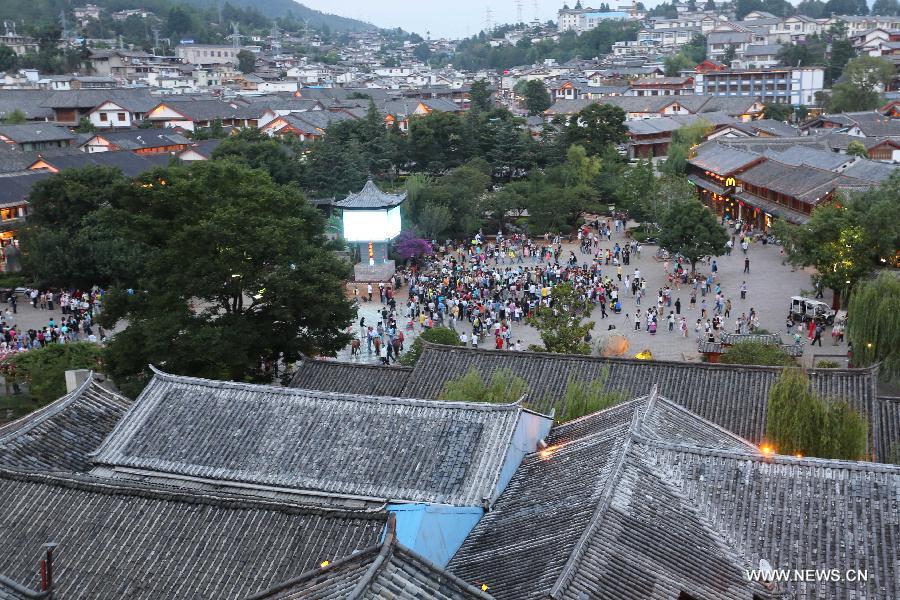
Tourists entertain themselves  in the old town of Lijiang, Yunnan Province, Aug. 8, 2012. The old town of Lijiang, a UNESCO World Heritage site with a history of more than 800 years, was formally licenced as the national 5A tourism attraction spot, the top one among China's tourism ranking system, on July 27, 2011. During the first six months of 2012, in total 8.0934 million people visited Lijiang, increasing by 55.93 percent year on year. The tourism industry's revenue of the same period reached 10.395 billion RMB yuan (1.634 billion U.S. dollars), growing by 56.14 percent. (Xinhua/Lin Yiguang)

Kunming to offer 72-hour visa-free stays

The city of Kunming in southwest China's Yunnan Province is expected to become the fourth Chinese city to offer international transit passengers 72-hour visa-free stays.
Yunnan Airport Group Co., Ltd. and Yunnan's provincial tourism development commission plan to apply for a 72-hour visa-free stays for international passengers at the Kunming Changshui International Airport in the latter half of the year, the airport group said Friday.

Yunnan will create related tourism products to attract more international tourists once the application is approved, according to the group.
Yunnan Airport Group Co., Ltd. runs the Kunming Changshui International Airport.
South China's city of Guangzhou started offering international transit passengers 72-hour stays on Aug. 1, becoming the third Chinese city to introduce a visa-free policy following Beijing and Shanghai.
Source: xinhua via china.org.cn

Monday, 29 June 2015

Ancient town Lijiang in SW China


Tourists visit the Old Town of Lijiang, Yunnan province, June 23, 2013. (Source: Xinhua)

Wednesday, 24 June 2015

The Cultural Landscape of Honghe Hani Rice Terraces in Yunnan Province


The UNESCO's World Heritage Committee inscribed China's cultural landscape of Honghe Hani Rice Terraces onto the prestigious World Heritage List on Saturday June 22th 2013, bringing the total number of World Heritage Sites in China to 45.

The Cultural Landscape of Honghe Hani Rice Terraces, China covers 16,603-hectares in Southern Yunnan. It is marked by spectacular terraces that cascade down the slopes of the towering Ailao Mountains to the banks of the Hong River. Over the past 1,300 years, the Hani people have developed a complex system of channels to bring water from the forested mountaintops to the terraces. They have also created an integrated farming system that involves buffalos, cattle, ducks, fish and eel and supports the production of red rice, the area’s primary crop. The inhabitants worship the sun, moon, mountains, rivers, forests and other natural phenomena including fire. They live in 82 villages situated between the mountaintop forests and the terraces.

The villages feature traditional thatched “mushroom” houses. The resilient land management system of the rice terraces demonstrates extraordinary harmony between people and their environment, both visually and ecologically, based on exceptional and long-standing social and religious structures.

Source: Xinhua/Unesco

Thursday, 28 May 2015

Xishuangbanna, Home to China's last wild elephants

Xishuangbanna, Home to China's last wild elephants, a vast expanse of rainforest and unique local culture, is a perfect escape into nature

Lying on the Mekong River in Yunnan province, Xishuangbanna is the only tropical rainforest nature reserve in China and home to the country's last wild elephants.

Often called Aerial Garden and previously known as Mengbanaxi, which means fantastic utopia, the region offers an escape into luxuriously tropical forest alive with animals and insects.

It is also home to 13 ethnic groups. The majority group is the Dai. Others include the Hani, Wa and Yao.

Before becoming a tourist draw for its elephants and nature, the area was famous for Water Sprinkling
Festival, which marks the Dai peoples' new year. Lasting three days, from April 13 to 15, on the first day cultural performances are held and there are dragon boat races. On day two people sprinkle water on each other as a way of expressing good wishes. And on the third day, people exchange gifts.

Although Water Sprinkling Festival has already passed this year, there are many other events to come, including dragon boat races, firing of indigenous missiles and flying Kongming Lamps.

For those traveling on from China, the 966-kilometer border with Myanmar and Laos is a main crossing point into southern parts of Asia.

Here are also some of the region's main attractions:

1. Wild Elephant Valley 

Among the Dai people, elephants are a sign of good luck and longevity so it is perhaps fate that the last wild elephants in China live in Xishuangbanna.

About 45 kilometers from Jinghong city, the region's capital, Wild Elephant Valley is equipped with viewing platforms.

Three hundred elephants live in the dense forest of Xishuangbanna, known locally as the "kingdom of elephants".

An elephant training school in the valley houses 16 tamed elephants that have been taught to perform tricks such as bowing, standing on their heads, dancing and kicking balls. Tourists can ride the elephants, have their photograph taken with them or enjoy an elephant massage.

2. Single Tree Forest

This 900-year-old Banyan tree in the town of Daluo is a favorite scenic spot for many. With more than 30 different strands of surfacing roots, the "forest" it creates spans 120 square meters beneath its towering 70-meter-tall trunk.

Aerial roots growing from the trunk twist and cross each other on their way to the ground, creating the feeling that there are many trees.

3. Manfeilong Buddhist Pagoda

Situated on the top of a hill near Manfeilong village, 70 kilometers from Jinghong city, the Manfeilong Pagoda was built in 1024.

Because of its appearance it is also known by two other names, White Pagoda and Bamboo Shoot Pagoda. It is dedicated to Hinayana Buddhism, which is a small, conservative branch of Buddhism.

The Manfeilong Pagoda consists of nine towers. The main tower is 16.3 meters tall and surrounded by eight smaller towers, each 9.1 meters tall.

Made of bricks, with club-like bases topped by calabash-shaped bodies, each tower contains a niche in which sits a Buddhist statue.

To the south of the pagoda is a footprint in the rock, which according to legend was left by Sakyamuni, the founder of Buddhism.

The pagoda attracts Buddhists from Myanmar and Thailand, and during the Water Sprinkling Festival crowds of Dai people from Manfeilong village gather in front of the pagoda to celebrate the new year.

4. Olive Dam

Named for its shape, Olive Dam (Ganlanba) is the lowest and hottest place in Xishuangbanna and home to the Dai people, who live in wooden houses on stilts. The two main Dai villages are Mansongman (garden village) and Manting (fruit garden).

Located along Lancang River and known for its beauty, the region, which holds a bounty of tropical fruits, is also sometimes called Menghan, which means roll up.

The name comes from a legend that when the Buddhist preacher Sakyamuni came to the area his followers laid out a cotton cloth for him to walk on, which they later rolled up.

Source: China Daily

Wednesday, 25 March 2015

The Stone Forest


The Stone Forest or Shilin (Chinese: 石林) is a set of limestone formations located in Shilin Yi Autonomous County, Yunnan province, near Shilin approximately 120 kilometers from Kunming.

These formations, caused by the dissolution of limestone, are believed to be over 270 million years old and are a tourist attraction for both overseas and domestic tourists, with bus tours bringing tourists from Kunming. There are also a number of hotels in the area.

Since 2007, two parts of the site, the Naigu Stone Forest (乃古石林) and Suogeyi Village (所各邑村), have been UNESCO World Heritage Sites. 

According to legend, the forest is the birthplace of Ashima (阿诗玛), a beautiful girl of the Yi people. After falling in love she was forbidden to marry her chosen suitor and instead turned into a stone in the forest that still bears her name.  (Source: Fotopedia)

Thursday, 5 March 2015

Faces of Yunnan Province, China


Shangri-La County


Shaxi


Dali City


Naxi Ethnic Minority, Lijiang


Naxi Ethnic Minority, Shangri-La County


Naxi Ethnic Minority, Old Town in Jijiang


Naxi Ethnic Minority, Tiger Leaping Gorge


The Hani people are an ethnic group. They form one of the 56 nationalities officially recognized by China.


Shaxi is a historic market town in Jianchuan County. The two main ethnic groups of Shaxi are the Bai and Yi people.


The Bai or Baip are one of the 56 ethnic groups officially recognized by China. They numbered 1,858,063 as of 2000.


Erhai lake is an important food source for the local people (Bais).

Source: Fotopedia 

Wednesday, 4 March 2015

Dali- A backpacker heaven


Dali's interesting ethnic culture, enticing food, ancient architecture - including a city wall and moat - and sub-tropical climate have placed it firmly at the top of many travelers destinations in China and earned it the moniker "backpacker heaven".

The Bai ethnic group has lived in the Dali area for thousands of years and still accounts for 65 percent of the population. Their culture, which includes a multitude of celebrations - among them the Butterfly Festival and the March Street Festival in spring - is a huge draw for tourists.

In northwest Yunnan province, 300 kilometers from the region's capital, Kunming, Dali sits between Cangshan Mountain to the west and Erhai Lake to the east. Both of these natural spots are popular trips for visitors from China and abroad to Dali.

Here are some of the main attractions.

1. Cangshan Mountain 

Its 19 peaks rise 3,500 meters above sea level, creating an undulating landscape dotted with rocks and springs and in parts shrouded in cloud. Snow on the mountaintops remains unmelted year-round and sparkles in the sun.

The mountain is a national park and home to some of the rarest camellia flowers in China. Flower and bird enthusiasts should stay at least one night at a mountain guesthouse to enjoy the natural beauty and serenity of the mountain, the equal of which is hard to find in China.

The main path on Cangshan Mountain is called the Cloud Traveler's Path, which crosses 18 streams and winds its way through dense forest.

As altitude changes along the path, so too do the clouds, at times becoming as thin as silk and at others as thick as jade. It you come across a cloud that resembles a fairy holding a jade belt it is supposedly a sign of good health, according to Bai legend.

When it is shrouded in cloud, a walk on the mountain can be a surreal experience, while on a clear day it offers spectacular views of the entire Dali valley.

2. Three Pagodas

Located at the foot of Cangshan Mountain and facing Erhai Lake, Three Pagodas is one of the best-preserved Buddhist structures in China.

The central structure, Qianxun Pagoda, is one of the tallest remaining pagodas of the Tang Dynasty (AD 618-907) at 69.13 meters. To its north and south stand two smaller pagodas. Along with Zhaozhou Bridge in Hebei province and Big Wild Goose Pagoda in Xian, Shaanxi province, Three Pagodas is considered one of the architectural wonders of the Tang Dynasty.

Its complex structure and beauty reflect the Buddhism that once swept the entire region.

Congshen Temple, which is behind Three Pagodas, was recently rebuilt. It contains sculptures of Buddha made from wood, silver, gold and crystal.

Those energetic enough to climb to the top of the main pagoda are rewarded with a panoramic view of Dali and Erhai Lake.

Following the pagodas, a visit to the nearby Marble Market, which is lined with souvenir shops, many selling Dali's unique marble carvings, makes an interesting diversion.

3. Erhai Lake

One of China's largest highland lakes, Erhai Lake means "ear-shaped sea" in Chinese. The lake, which is next to Cangshan Mountain, covers an area of 250 square kilometers and is shaped in a crescent curling around Dali. It was a natural protection for the town in more dangerous times.

On a sunny day shreds of sunlight streak down upon this watery armor, dispersing on its surface to create a shimmering pool of color that contrasts with the glistening pinnacles of Cangshan Mountain. This is commonly referred to as "Silver Cangshan and Jade Erhai".

Ferries and paddle boats wait to take travelers around the lake, where they can watch trained cormorants working with fishermen to bring in their daily catch.

There are also a number of islands and temples around the lake that are worth visiting, including Golden Shuttle Island and Guanyin Temple.

4. Local Food

Dali is known for its Bai ethnic dishes. Stewed carp casserole is a local delicacy, normally served as a main course with 28 different ingredients and numerous seasonings.

Steamed chicken is cooked in a pot and the circulating vapor inside makes the chicken taste more tender than typically boiled or stewed chicken, especially when traditional Chinese herbs are added.

Dairy Fan is a popular snack made of milk and yogurt, shaped like a fan, which is served at stalls dotted throughout Dali.

Another favorite local snack is Ba Ba, a tiny baked pancake with onions and diced ham.

Source: China Daily

Saturday, 31 January 2015

Erhai Lake, Yunnan Province


Erhai Lake  is an alpine fault lake in Yunnan province, China. Its name means "Ear-shaped Sea", due to its shape as seen by locals and travellers. Er Lake was also known as Yeyuze or Kunming Lake in ancient times.  (Wikipedia)

Source: Fotopedia