Harbin is the capital of Heilongjiang Province, China's northeastern-most region. With its arctic climate and abundant ice and snow, the city is known as China's "Ice City." The architecture in Harbin gives the city its nickname of "Oriental Moscow" and "Oriental Paris."
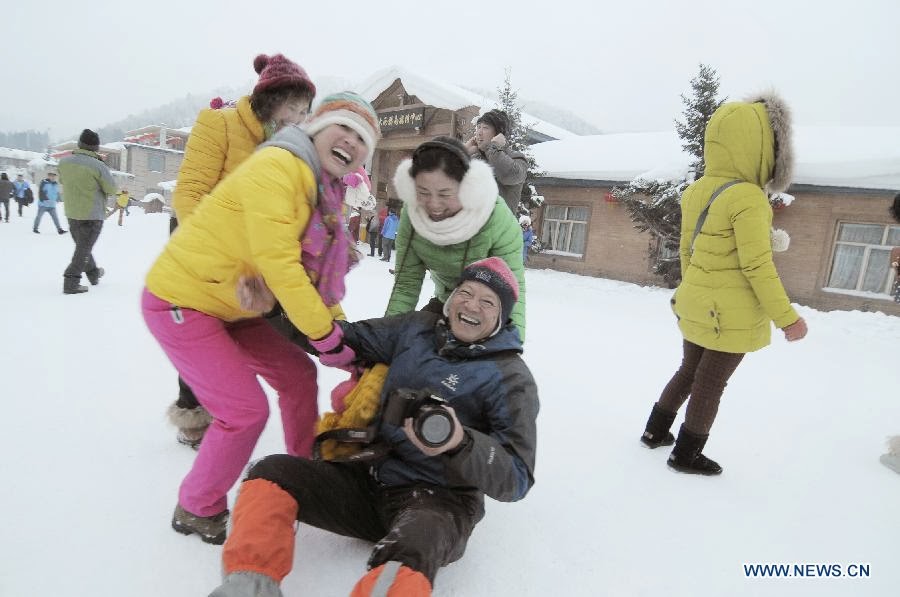
Since 1963, the world-famous Harbin International Ice and Snow Festival has been hosted in January of each year. During that time, exquisite ice sculptures are decorated with colorful ice lanterns and winter sports competitions attract thousands of local and overseas visitors.
If you visit Harbin, don't miss the Harbin Ice and Snow World -- by far the largest ice and snow art exhibition and amusement park in the world. The picturesque Sun Island Scenic Area and the Sophia Cathedral are also good choices for you to go.
Following are the top 10 attractions in Harbin, China
Sun Island Scenic Area

Located on the north bank of the Songhua River, the Sun Island Scenic Area is a famous resort in China. Surrounded by blue water, the area boasts crystal lakes, wooden rockeries, beautiful flowers and exotic buildings, covering a total area of 3,800 hectares.
In summer, the comfortable weather makes it the first choice to escape from the heat; in winter, the spot is a paradise of ice and snow. Every year, ice and snow sculptures and architecture are exhibited here, attracting thousands of visitors.
Admission:30 yuan (US$4.9)/person
Central Street in Harbin

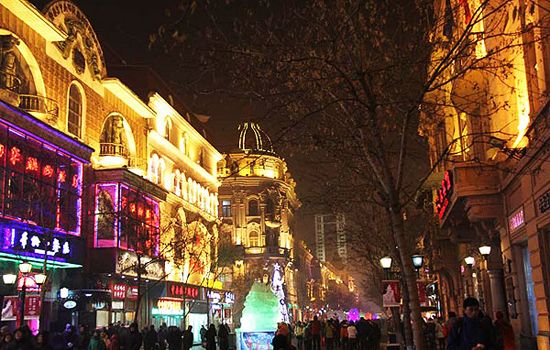
Known as the "Eastern Moscow," northeast China's Harbin has always been regarded a unique and exotic city. The Central Street in downtown Harbin is the city's ultimate symbol.
Harbin's 100-year-long history can be traced back to this story-filled street. Originally constructed in 1898, for the transportation of railway supplies and named the "Chinese Street," Central Street was later floored with square stones based on the design of a Russian engineer in 1924. Since then, it has become home to numerous foreign shops, hotels and bars. Russian leather, British woolen cloth, French perfume, German medicine and many more exotic commodities can be found here.
With a total length of 1,450 meters, Central Street is now the longest pedestrian street in all of Asia. The European architectural art is the most obvious feature of this long corridor and the four most influential schools of Western architecture from different eras -- including Baroque, Renaissance, eclecticism and Art Nouveau -- are all presented along the street. As Harbin's most cultural rich area and busiest commercial street, Central Street is an enthralling destination, attracting tourists both all over the globe.
Admission: Free
Saint Sophia Cathedral

The Saint Sophia Cathedral, or the Cathedral of the Holy Wisdom of God, is a former Russian Orthodox Church located in Harbin, capital city of Heilongjiang Province.
First built in 1907, the cathedral is the largest Orthodox Church in the Far East and is one of the most magnificent structures in the city. After being restored and rebuilt multiple times, it was turned into the Municipal Architecture and Art Museum in 1997, showcasing the multi-cultural architectural development of Harbin throughout the ages. It is hailed as a monumental work of art.
Admission: 20 yuan (US$3.27) /person
Harbin Ice and Snow World

Established in 1999, the Harbin Ice and Snow World is by far the largest ice and snow art exhibition and amusement park in the world, conveying the unique charm of both ice and snow culture and tourism. It usually opens in late December or early January and lasts around three months, along with the Harbin International Ice and Snow Sculpture Festival.
The ice carvings here are regarded some of the world's finest examples of frozen art, where visitors are able to admire some of the largest and most majestic ice-sculpted masterpieces to be found anywhere. It is also a center for various forms of entertainment, such as ice rock-climbing, skating, skiing, sliding, snow fights, ice golfing and ice archery. Special performances based on the festival's theme are put on throughout the event.
Admission: Adult: 300 yuan (US$49.01)/person; Kids: 160 yuan (US$26.14)/person (Subject to change each year)
Yabuli Ski Resort

Located some 23 kilometers (14.29 miles) to the southwest of Yabuli County, at 198 kilometers (123.03 miles) from Harbin, the Yabuli Ski Resort is the largest ski resort in China, as well as its largest ski training center. It is also the best ski resort in China in terms of slopes, types of slopes, length of slopes and overall services. It has hosted a number of games, including all snow-involving events of the 3rd Asian Winter Games.
The number of snow days averages around 170 and the skiing season lasts for nearly 150 days. The best time to visit the area is from mid-November until late March. The 11 slopes meet the demands from beginning to experienced skiers. Average snow fall is 30-50 cm in the lower areas and about 100 cm at the top of the mountain. The resort offers various kinds of service facilities, including hotels, bars, restaurants, a shopping mall and an aid station.
Admission: 10 yuan (US$1.63) / person
Erlong Mountain Scenic Spot

The Erlong Mountain Scenic Spot is situated in the east of Harbin, at 50 kilometers (31.07 miles) from the city center. Covering a total area of 25 square kilometers (2500 hectares), this lakeside scenic spot is surrounded by mountains on three sides. It is an ideal place for touristic recreation and sightseeing, especially in summertime. You can find many entertaining activities here, including skiing, sledding, rock climbing, mini bungee jumping, paintball, go-carting, biking and paragliding. The area welcomes nearly 1 million visitors every year.
Admission: 50 yuan (US$8.17) / person
Siberian Tiger Park

Located at the north bank of the Songhua River, the Siberian Tiger Park is the largest natural park for wild Siberian tigers in the world, covering an area of 1.44 million. It was opened to public in 1996, with the aim to save and protect the Siberian Tiger -- an endangered species.
There are more than 700 pure-bred Siberian tigers in the park, with 100 visible to visitors. Staying inside a bus, protected by wire mesh, visitors can see the tigers walking around. If you are brave enough, you can buy live animals to feed to the tigers, including ducks, chickens and even cows. In addition to the Siberian Tigers, white tigers, lions, lynxes, leopards and several other big cat types can be found in the park.
Admission: 90 yuan (US$14.7) / person
Dragon Tower

The Dragon Tower, known as the Heilongjiang Broadcasting & TV Tower, is a prominent Harbin landmark. At a height of 336 meters (1,102 feet), it is a multi-purpose steel lattice television and observation structure. It became a member of the World Federation of Great Towers on November 8, 2008.
The tower features an observation decks and platforms where visitors can have a picturesque view of the city's surrounding areas. It also features a dinosaur exhibition, a 4D theater, tower halls, walkways and buffet restaurants.
Admission: 150 yuan (US$24.5) / person
Volga Manor

The Volga Manor, located on the banks of the Ashi River, Xiangfang District of Harbin, is a tourist resort themed on Russian culture. Covering an area of 600,000 square meters (60 hectares), the manor shows the visitors marvelous views of its huge of gardening and marsh lands. The rivers, bridges, country views, together with the magnificent classical Russian-style architecture, will take you into a fairy-tale world. It is an ideal place for recreational activities, wedding ceremonies and outdoor events.
Admission:100 yuan (US$16.33)/ person
Jinyuan Cultural Tourism Area

The Jinyuan Cultural Tourism Area, located 2 kilometers (1.24 miles) south of Acheng City, Harbin, is a well-preserved site of the capital of Kin Dynasty (1115-1234). Today, the meridian Gate and palaces are in good condition, and the walls of outside city, barbican entrance, turret and moat are still there.
Acheng City is a historical site which was used to be the largest city and political, economic, military and cultural center of northeast Asia during the 12th century.
Admission:10 yuan (US$1.63) / person