Welcome

Showing posts with label Lhasa. Show all posts

Tuesday, 22 December 2015

Tibet's holy lake: Yamdrok Lake


Yamdrok Lake is one of Tibet's three holy lakes, along with Nam Co and Mapam Yum Co. It's the largest freshwater lake at the foot of the Himalayas. The 638-sq-km body of water is situated about 4,441 meters above sea level and is believed to be the woman guardian of Buddhism in Tibet.

A constant flow of pilgrims streams to the three lakes. The breathtaking Yamdrok Lake enjoys the advantage of being closest to Lhasa and the airport. Likewise, the road to reach Yamdrok is arguably in better condition than those leading to the other two holy lakes.

In addition, the drive along the two-lane road that wraps around the 4,800-meter-high Gampa-la Mountain is riddled with U-turns, offering views of changing landscapes and different seasons created by the varying altitudes.

Source: china.org.cn via xinhua

Saturday, 14 November 2015

Tibet's Medog County restricts tourist arrivals

Local authorities in Medog County, the last county in China to gain road access to the outside world, announced Wednesday it would decrease the number of tourists to fewer than 15,000 annually by 2015.
A highway linking Zhamog Township, the county seat of Bome County, and Medog in Nyingchi Prefecture in southeastern Tibet opened in October, putting an end to the isolation of a region once dubbed the "secret lotus."

The county government of Medog published a document on establishing a better tourism industry following the opening of the highway, which has attracted the interest of tourists worldwide.
Official statistics show that the region saw tourism arrivals of 29,900 from January to July, bringing total revenues of 6.57 million yuan (about 108,000 U.S.dollars).
Lhagpa, director of Medog County's tourism bureau, said the number of tourists annually will be restricted to under 15,000 by 2015 in order to better protect the region's ecological environment.
The government will preserve the nature and cultural landscape as well as explore a new route for hikers, according to the document.
Meanwhile, more than 100 local families will be involved in the tourism industry, and infrastructure will be greatly improved by the end of 2015.
Mountain paths connecting villages and towns were once the only travel routes, making foot travel and horses the only transportation methods in Medog, which has a population of 12,000.
An adobe road dug along cliffs was built in 1994, but has only been accessible between July and September. Frequent fatal traffic accidents have occurred on the poorly-built roads.
Construction of the new road was approved by the State Council, China's cabinet, in 2008. Work officially began in April 2009.
Source: xinhua via china.org.cn

Saturday, 17 October 2015

Scenery of Lhasa


Photo taken on Oct. 12, 2013 shows the night view on the Lhasa River, Lhasa, Tibet Autonomous Region


 Photo taken on Oct. 16, 2013 shows the Potala Palace in Lhasa, Tibet Autonomous Region

Photo taken on Oct. 13, 2013 shows the scenery from the top of the Ngaqen Mountain in Lhasa, Tibet

A follower of Buddhism walks past prayer wheels outside the Potala Palace in Lhasa, Tibet

A student writes homework at roadside in the sun in Lhasa, Tibet Autonomous Region

Source: Xinhua

Monday, 21 September 2015

Faces of Tibet

There are more than 10 ethnic groups living in the Tibet autonomous region. Ethnic groups living on the plateau not only keep traditions from generations past, but also face the modern way of life full of hope.

Yagpe, 82, a practitioner of divination demonstrates an ancient ritual in her kitchen in Chab Nag village, Mainling county, in July. The Lhoba ethnic group believed these fortune tellers represented a divine link between the gods and humanity and could heal the sick. She is one of just two such practitioners in the region as modern medicine has became more popular.

Maria, a Catholic, lives with her husband, a Buddhist, in Yargading village, Markam county. Tibet's unique Christianity has deep roots in the village.

Tsering Yudron (right), 40, owner of the Lhasa Smile teahouse, and clerk Zomkyi, 25, proudly display their establishment in Medog county, Nyingchi prefecture, in July. They came to the county in southeast Tibet from Lhoka prefecture three years ago to open the teahouse.

A young man enjoys a welcome respite from the July heat in a teahouse in Medog county. There are only 10 KTV-style entertainment venues in this area where the Tibetan-style teahouses are popular.

Members of the Tibetan ethnic group take a well-earned moment of rest from the highland barley harvest in Qamdo prefecture in July. Highland barley has been grown on the plateau for centuries, and wine made from the crop is a popular refreshment. People on the plateau live in harmony with the land and the circle of nature.

Source: China Daily

Wednesday, 19 August 2015

Must-read for foreigners to travel in Tibet

For foreign tourists who want to travel to the Tibet autonomous region, two documents are needed before departure: the Chinese Visa, which you can apply for in the Chinese Embassy in your country and the Tibet Travel Permits (TTP), which you have to obtain in advance in order to enter Tibet smoothly.
All foreign tourists must hold a passport valid for at least six months. If you enter Tibet from inland China, your Chinese visa must be valid. However,entering Tibet from Nepal, either through the Friendship Highway or by air requires a separate visa valid for Tibet from the Chinese Embassy in Katmandu (30-60 day visas are the norm and it usually takes two weeks to obtain it.)

Who needs a permit?
In order to protect the centuries-old cultural relics, the fragile environment and respect the tradition of Tibetan people and considering the limited reception capacity in Tibet, the China National Tourism Administration asks all foreign tourists to apply for Tibet Travel Permits (TTPs for short) issued by the Tibet Tourism Bureau or its branches before entering Tibet.
Overseas Chinese and Taiwanese are also included in the stipulation, while Hong Kong and Macao residents need a Home Return Certificate instead.
Foreign tourists need to show TTPs when booking tickets or checking in at the airport.
How to apply?
To apply for a TTP, foreigners have to send their personal information including full name, gender, nationality, occupation, passport number as well as traveling route, time of traveling and contact information to any assigned offices of the Tibet Tourism Bureau directly or via the travel agency.
The assigned offices of the Tibet Tourism Bureau are now available in Beijing, Shanghai, Chengdu of Sichuan Province and Golmud of Qinghai Province.
The travel agency will return you a confirmation letter upon finishing the procedures. Only with the confirmation letter in hand can you buy a ticket to Tibet and pass the airport check-in counter.
Notes
1.It's advisable to apply for your travel permit at least 10 days prior to your entry date.
2.After you have got a permit, your travel agency can buy the air/train tickets for you.
3.The travel agency is unable to help you get the permit if you do not book any tour package from them. At present, no travel agency can provide permit-only service.
4.If you want to travel into border areas such as the base camp of Mt.Qomolangma, the Zham Township or the Medog County, a border pass is required both for Chinese and foreign visitors. The border pass is only available in Lhasa, where processing will take several days.
Tips:
Following are some of the areas where a border pass is needed. The list only includes the most popular places.
1.Shigatse Prefecture: Zhongba county, Sagya county, Nylam county (Zham), Tingri county, Kangma county, Yadong county, Gampa county, Dinggye county, Gyirong county.
2.Lhoka Prefecture: Cona county, Lhongzi county, Lhodak county, Nanggarze county.
3.Nyingchi Prefecture: Mailing county, Nang county, Zayul county, Medog county.
4.Ngari Prefecture: Burang county, Zhada county, Rutog county, Gar county, Shiquanhe township.
Source: Tibet.cn via China Daily

Monday, 20 July 2015

Tibetan farmers enjoy Onkor festival

How do the farmers in the Tibet autonomous region prepare for harvest? They pray and have fun during the Onkor Festival that lasts for three to five days before the heavy work.

The specific dates of the festival, which is only second to the Tibetan spring festival for the farmers, vary from place to place depending on when the crops that are ready for harvest.

In Doilungdeqen county to the south of Lhasa, this year's three-day celebration started on Wednesday as the barley was ready for harvest.

"We've prepared for the festival for a week, feeding the horses good forage and preparing nice food for the family. Many friends and relatives also come during the festival," said 59-year-old Urgyen.

Onkor means "looking around the field" in Tibetan, which is why people put on ancient warrior's clothes, ride horses decked out in fancy colors and trot through the fields.

People also sing, dance, play drums and gongs and enjoy horseracing and contests.

Urgyen's grandson, Dondrup, 8, was one of youngest riders at the festival.

"I'm afraid he will be too busy to join the festival when he goes to college and starts working. Hopefully, he will always remember our traditions," Urgyen said.

The festival has a history of more than 1,500 years. To ensure a plentiful harvest, the then Tibetan king asked the hierarchy of the local Bon religion for guidance. Following the tenets of that faith, farmers walked around their fields, asking the heavens for a good harvest, which was the origin of the Onkor. It was later tinged with aspects of Buddhism.

Source: By Tang Yue and Li Zhou in Lhasa (China Daily)

Friday, 27 March 2015

Booming tourism puts heritage sites under threat

Source: Xinhua via China Daily

Booming tourism in the Tibet autonomous region is putting the preservation of its centuries-old heritage sites under unprecedented threat, according to experts.

The local tourism administration is expecting a record 10 million visitors to Tibet this year, a "real challenge" for Tenzin Namgyal, deputy chief of Tibet's cultural heritage administration.

"The boom will certainly bring wealth, but it will also put the safety of Tibet's heritage sites to the test," he said, ahead of the start of the tourist season in May.

Tibet has 4,277 major cultural heritage sites, mostly monasteries.

"These are often centuries-old mud and wood structures that are extremely vulnerable and need immediate protection," he said.

Particularly since the 2006 opening of a railway to Tibet, visitors have flocked to these monasteries, putting unprecedented pressure on the already ramshackle structures.

"Some monasteries suffer subsidence, some have deformed walls and many of the precious frescos are damaged by temperature and humidity changes and excessive exposure to flashlights," said Tenzin Namgyal.

He believes the situation could deteriorate as the number of visitors continues to rise.

Tibet has reported an average 30 percent increase in the number of visitors annually in recent years, said Tsewang Tashi, vice president of the regional federation of industry and commerce.

In 2011, nearly 8.7 million trips were made by visitors from home and abroad to Tibet.

Meanwhile, the plateau region is planning to draw 15 million visitors annually by 2015.

"Tibet is facing a dilemma: tourism authorities want more visitors and higher revenue, while we, as heritage guardians, want fewer tourists to keep the sites safer," noted Tenzin Namgyal.

The regional government, he said, has worked hard to settle on compromises that meet the demands of both sides.

One significant move was to encourage visitors to travel during the slack seasons of fall and winter. Last year, Tibet's tourism authorities and companies offered special winter tourism packages.

Meanwhile, authorities are cracking down on ticket scalpers at major destinations, including the Potala Palace.

The palace was built in the seventh century and expanded during the 17th century. It was placed on UNESCO's list of world cultural heritage sites in 1994.

This year, the palace will receive an estimated 1.3 million visitors, up from last year's 1.16 million, said Khyungda, an official with the Potala Palace administration.

Between May and October, the administration places a daily limit of 4,000 on visitor numbers for safety. This year, it has installed a 4 million yuan (US$630,000) system to monitor visitor flow.

China's central government has invested heavily in preserving heritage sites in Tibet.

In the five years from 2011 to 2015, it will spend an estimated 1.7 billion yuan on preserving Tibet's cultural heritage, at least 300 million yuan more than the total over the past three decades.

Tuesday, 17 June 2014

Ranwu Lake, Tibet


Like many lakes in Tibet, the Ranwu Lake, located beside China's National highway 318, is also a barrier lake. Centuries ago, there was no lake to be found, with only a river course at the higher range of the Yarlung Tsangpo River. A crustal movement 200 years ago caused the collapse of the surrounding mountains; rocks blocked the river course, forming the Ranwu Lake.

The lush grass surrounding the lake, the sky-blue river and the white snow-capped mountains form a picturesque view. The long and narrow Amucuo Lake, stretching on for tens of kilometers to the west, gradually shrinks to a river valley. As the season changes, the river presents different colors including azure blue and dark green. The valley is dotted with rocks and small islands. In spring, the shadows of trees dance on the surface of the lake. In both autumn and winter, the lake is shrouded by mist and fog. The view of the four seasons can lead you into a realm of fantasy.

Source: CRI

Friday, 16 May 2014

Top attractions in Lhasa, China


Potala Palace

The Potala Palace is considered to be a model of Tibetan architecture. Located on the Red Hill in Lhasa, it covers more than 360,000 square meters and has 13 storeys. It was first constructed in 641, by Tibetan King Songtsen Gampo, in order to welcome his bride, Princess Wencheng of the Tang Dynasty. This structure was later burned to the ground during a war and rebuilt in the 17th century by the Fifth Dalai Lama. Over the past three centuries, the palace has gradually become a place where the Dalai Lama lives and works and a place for preserving the remains of previous Dalai Lamas.

Admission: 200 yuan (US$32.25) (May 1-Oct.31); 100 yuan (US$16.11) (Nov. 1-Apr. 30)


Jokhang Temple

Jokhang Temple, located on Barkhor Square in Lhasa, is Tibet's first Buddhist temple and is part of the Potala Palace. The temple used to be called Tsulag Khang ("House of Wisdom"), but is now known as Jokhang ("House of the Buddha"). It is the ultimate pilgrimage destination for Tibetan pilgrims. 

Featuring Tang Dynasty architecture, Jokhang Temple is a four-story timber complex. A statue of Sakyamuni at the age of 10 is one of only three statues designed by Sakyamuni himself.

Admission: 85 yuan (US$13.71)

Namtso Lake

Namtso, or Lake Nam, is one of three holy lakes in the Tibet Autonomous Region and should not be missed by any traveler to the region. In Tibetan, Namtso means "Heavenly Lake." It is famous for its high altitude and imposing scenery. The second largest salt lake in China, Namtso covers 1,920 square kilometers and is also the second-highest salt lake, in terms of altitude, in the world at an elevation of 4,718 meters above sea level.

Admission: 120 yuan (US$19.35) (May 1-Oct.31); 60 yuan (US$9.67) (Nov. 1-Apr. 30)

Norbulingka

Norbulingka, literally the "Jeweled Garden," is a palace and its surrounding parks located in a western suburb of Lhasa. It was constructed in the 1740s as a summer palace for the Dalai Lama and later served the whole governmental administration. The place boasts typical Tibetan palace architecture, as well as gentle streams, dense and lush forestry, birds and animals. Covering an area of around 36 hectares, it is considered to be the largest man-made garden in Tibet. Being part of the "Historic Ensemble of the Potala Palace," Norbulingka is recognized as a UNESCO World Heritage Site, and was added as an extension to this Historic Ensemble in 2001.

- Admission: 60 yuan (US$9.67)

Barkhor

Barkhor is a small neighborhood consisting of ancient streets and a public square surrounding Jokhang Temple in the old area of Lhasa. The oldest street appeared about 1,300 years ago, right after Jokhang Temple was built in 647, attracting thousands of Buddhist pilgrims. The streets are filled with a religious atmosphere and show the original Lhasa. Shops offer prayer wheels, chubas (traditional Tibetan clothing), Tibetan knives and religious article.

- Admission: Free

Yambajan

Yambajan is famous for its wide range of hot springs, ranging from those with the highest temperatures in all of the country to boiling geysers. It sits in a basin at the foot of the Nyainqentanglha Mountains some 90 kilometers northwest of Lhasa. In the early morning, the town is covered in a white and luminous vapor. The hot springs in Yambajan contain various minerals and are believed to be therapeutic.

- Admission: 30 yuan (US$4.83); Hot-spring bathing: 98 yuan (US$15.79)

Drepung Temple

Built in 1416, the Drepung Monastery is situated at the foot of the Mountain Gambo Utse, about 10 kilometers (3.1 miles) to the western suburbs of Lhasa. It is the largest and most influential monastery of the Gelug Sect, a branch of the Tibetan Buddhism, in posses of 141 manor and more than 540 ranches.

Together with the Ganden Monastery and the Sera Monastery, Drepung Monastery is regarded as one of the "Three Great Monasteries" in Lhasa.

- Admission: 55 yuan (US$8.86)

Ramoche Temple

Remoche Temple, a Tibetan Buddhist monastery, is considered to be the most important temple in Lhasa after the Jokhang Temple. Located in the north part of the city, it is about 500 meters from the Jokhang Temple, covering an area of 4,000 square meters. First built in the middle of the 7th century during the Tang Dynasty (618-907), the same time as the Jokhang Temple, the Remoche Temple boasts a long history, with a nickname of "Minor Jokhang Temple." Ramoche Temple was supervised by Prince Wencheng and designed and constructed by craftsmen from the inner China, so its early buildings resemble the style of the Tang Dynasty.

- Admission: 20 yuan (US$3.22)

Tibet Museum

Located in Lhasa, the Tibet Museum is the first large and modern museum within the Tibet Autonomous Region. It was inaugurated in October 1999, with a permanent collection related to the cultural history of Tibet. Covering a space of 53,959 square meters, the museum displays more than 1,000 artifacts, including Tibetan art and architectural design such as Tibetan doors and beams.

- Admission: Free

Ganden Monastery

Ganden Monastery, also known as Gaden Monastery, is one of the "great three" Gelukpa university monasteries in Tibet, together with the Sera Monastery and the Drepung Monastery. Located at the top of Wangbur Mountain, Tagtse County, Ganden Monastery was built in the seventh year of the Yongle Reign (1409) during the Ming Dynasty (1368-1644).

Ganden Monastery consists of over 50 structures and main halls include the Main Assembly Hall (or Coqen Hall), Zhacangs, Khangtsens, and Myicuns. Coqen Hall is positioned in the northern part of the temple and faces south; it is the largest assembling hall. It has three storeys and is 43.8 meters wide and 44.7 meters long. It features the statues of the Maitreya Buddha and the master Tsong Khapa, the initiator of Gelugpa. In addition, it also has many rare and precious cultural relics, such as Qing Dynasty (1644-1911) armor.

- Admission: 40 yuan (US$6.44)

Source: china.org

Wednesday, 2 April 2014

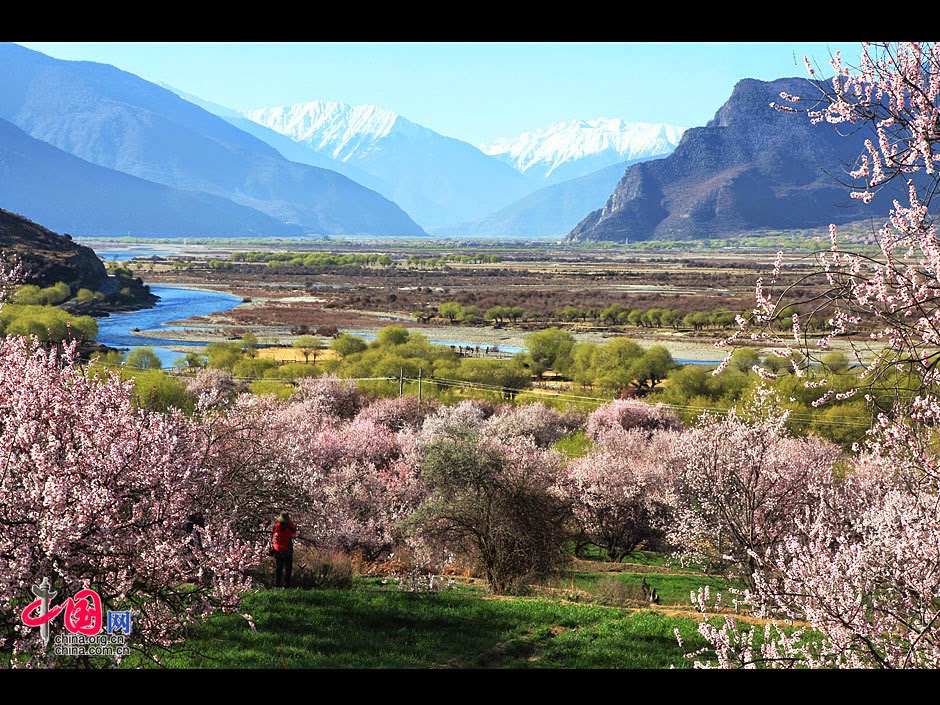
Follow the peach blossoms to Nyingchi


Nyingchi, or Linzhi in Chinese, lies in the southeast part of Tibet Autonomous Region. Located near the lower reaches of Yarlung Zangbo River, it is blessed with a semi-humid climate and fascinating scenery. With a large number of river valleys and alpine gorges, Nyingchi is also called the "Switzerland of Tibet".

When travelling there, you will be amazed by the lofty snow-capped mountain peaks, well-preserved original forests, cypresses that can grow up to thirty meters, and numerous colorful grasses. Travelers can also take part in various activities, such as mountain hiking, rock climbing and white water rafting, and experience the unique local customs of the Menba and Luoba people.

Source: china.org

Monday, 31 March 2014

Nyang River in Linzhi, Tibet


Photos taken March 29, 2014- The Nyang River in Linzhi County, Tibet Autonomous Region.

The 307.5-kilometer Nyang River is a major tributary of the Yarlung Zangbo River

Source: Xinhua

Sunday, 23 March 2014

The Gahai Lake Wetland's in Tibet


Gahai Lake is located in the Gannan Grassland's at an altitude of 3,400 meters.  The area around the lake is home to 222 species of birds


Whooper swans from Mongolia rest in Gahai Lake, Gannan Tibetan autonomous prefecture. The lake is a breeding-ground for birds, flocks of geese and ducks, brown-headed gulls and hundreds of other species of birds

Black-necked cranes play in the Gahai Lake wetland

White swans spend winter at Gahai Lake, located in Gannan Tibetan autonomous prefecture, every winter and leave around March

Whooper swans from Mongolia spend winter in Gahai Lake Wetland, Gannan Tibetan autonomous prefecture


Source: CRI

Wednesday, 26 February 2014

Kanbula National Forest Park in Tibet


Located in Huangnan Tibetan Autonomous Prefecture, 131 kilometers (81.4 miles) from Qinghai’s capital city Xining, the Kanbula National Forest Park is an ideal place for traveling, sightseeing, vacation, camping and scientific expeditions. Covering an area of 152 square kilometers (15,200 hectares), the park is famous for its unique landform of red gravel rocks, and features forest vegetation, lofty mountains, soaring peaks crystal water and Tibetan culture


Source: china.org.cn