Welcome

Friday, 18 December 2015

Billionaire Cheng’s NWS to Buy Stake in Beijing Airport

NWS Holdings Ltd. (659), controlled by Hong Kong billionaire Cheng Yu-tung, agreed to buy a stake in the operator of China’s biggest airport from sovereign-wealth fund GIC Pte, betting on a surge in travelers.

NWS will buy 8.8 percent of Beijing Capital International Airport Co. (694) for about HK$2.36 billion ($304 million), according to a Hong Kong stock exchange filing yesterday. The purchase of 383 million shares at HK$6.15 apiece will give the transportation unit of New World Development Co. (17) a 20.4 percent stake in the airport operator’s Hong Kong-listed H shares.

The acquisition, at a 2.1 percent discount to the stock’s closing price yesterday, gives NWS an exposure into the booming air travel market in Beijing, ranked the world’s second-busiest airport after handling 82 million passengers last year. As disposable incomes rise in China, there is “potential growth” in revenue at the airport from retail concessions, advertising and rentals, NWS said in its statement.

“Beijing Capital International Airport is a quality infrastructure asset with substantial stature and a key correlation to the continuous growth of China’s economy,” NWS said in the filing. It’s NWS’s first investment in an airport, according to an e-mail from the company today.

NWS shares fell 3.3 percent to close at HK$11.72 in Hong Kong trading. Beijing Capital International Airport gained 0.3 percent to HK$6.30. The city’s benchmark Hang Seng Index rose 0.3 percent.

Billionaire Cheng

GIC owned 413.9 million H shares in Beijing Capital International Airport as of Dec. 31 last year, according to data compiled by Bloomberg. GIC declined to comment in an e-mail.

Beijing, with an airport code PEK, handled 82 million passengers in 2012, an increase of 4.5 percent, according to the International Air Transport Association. Atlanta was the world’s busiest, handling 95.5 million passengers.

Cheng is Hong Kong’s fourth-richest man with a net worth of $20.1 billion, according to the Bloomberg Billionaires Index. Cheng owns 89 percent of Chow Tai Fook Jewellery Group, the largest jeweler in China and Hong Kong. Through Chow Tai Fook Enterprises, his closely held investment company, Cheng also controls New World Development, a land developer with holdings in hotels, retail, infrastructure and public transportation.

Source: Bloomberg News By Joshua Fellman and Jasmine Wang

Nanxun Ancient Town: Silk Capital of Zhejiang Province


Located 30 kilometers east of Huzhou, Zhejiang Province, Nanxun Ancient Town is a famous historical and cultural area with a 1400-year history. Due to the development of its silk industry, it has become an important commercial town in Zhejiang Province. In poems, it is described as thousands of households gather here on this water town market, and fishing boats and merchant vessels are called to it side by side


Source: cri

Thursday, 17 December 2015

Budget Airlines Look to Taiwan, Hong Kong

Asia's skies are about to become more crowded. At least 10 new budget carriers are expected in the region by the end of next year, expanding fare choices for consumers but squeezing airline profit margins even more.
The growth in new routes is shifting east to highly congested and expensive centers such as Taiwan and Hong Kong, though Southeast Asia remains a lucrative market as more people turn to budget travel.

On Monday, Taiwan's China Airlines Ltd. said it would team up with Singapore's Tiger Airways Holdings Ltd. to launch Taiwan's first budget carrier, hoping to link neighboring tourist and business hot spots when it starts service in the fourth quarter of 2014.
TransAsia Airways Corp. in Taiwan is also planning its own low-cost airline, while two other budget operations are being launched in neighboring Hong Kong, a first for the Chinese city.
"Taiwan is in an ideal location for low-cost carriers because the flight time to most destinations in Southeast and Northeast Asia is within four hours," said Huang-Hsiang Sun, chairman at China Airlines. The carrier will own 90% of Tigerair Taiwan, with the rest to be held by Tiger.
Taiwan has been slow to embrace budget-airline travel because of a small domestic market, while earlier restrictions on air rights made it difficult for airlines to develop regional and international services.
The popularity of budget flights has forced many national carriers to slash fares to better compete against low-cost carriers.
In Southeast Asia, where bustling economies and thrifty passengers have kept budget airlines profitable, low-cost carriers account for more than 52% of air capacity, according to consultancy CAPA-Centre for Aviation.
That is more than double their share for all of the Asian-Pacific region. Fares between routes such as Singapore to Kuala Lumpur in Malaysia go for as low as US$20 on budget airlines, making the rates comparable with those of road-based transportation.
Faced with increased competition at home, established budget-airline brands in Southeast Asia have expanded business into more costly locations in East Asia such as Japan, while South Korean airlines have started their own budget ventures. The new low-cost airlines in Hong Kong and Taiwan reflect an extension of their eastward push.
But analysts and industry executives say that market still remains largely unproven, given the challenges of achieving scale alongside high airport fees and traffic bottlenecks. An executive at low-cost carrier Jetstar Japan Co. said earlier that ground-handling fees at the nation's airports are "several times higher" than those in Singapore, adding to the airline's cost burdens.
"Profit margins are very thin in East Asia because of high operating costs. Unless there's strong government support, it will be very difficult for budget airlines here to achieve high utilization rates and turnaround times for their planes in order to turn profitable," said Kelvin Lau, an airline analyst at Daiwa Securities. Adding to the constraints are the limited takeoff and landing slots at airports such as Hong Kong during daytime and evening peak hours.
But there is significant room for growth. In Hong Kong and Taiwan, budget airlines account for only 5% of available seat capacity, according to some market estimates, compared with about 30% to 35% in Singapore.
Budget carrier Hong Kong Express Airways Ltd. sold more than 200,000 seats in just two-and-a-half months since its launch, after the former full-service airline converted into the city's first short-haul budget airline.
"We've sold nearly 50% of our entire seat inventory for the winter season from November through March. That really shows that Hong Kong people are hungry for low-fare opportunities," said Andrew Cowen, deputy chief executive at Hong Kong Express. Fares between Hong Kong and Tokyo are selling for as low as 736 Hong Kong dollars (US$95) round trip, about one-fourth of what is being charged by premium carriers on the route.
Mr. Cowen said the difficulty of securing slots in Hong Kong and other airports because of congestion is a stumbling block. "One of the biggest constraints to us is the airports. We've obviously got congested terminals. We're having difficulties getting the slots that we need."
By contrast, many Southeast Asian airports have the capacity to handle much more budget-related traffic. At Kuala Lumpur's airport—home to AirAsia Bhd.—budget-airline flights often exceed those of full-service airlines. AirAsia has kept its costs low and stayed profitable despite rapid expansion and intense competition.
The eastward expansion among budget airlines is taking place even as they continue to ratchet up their presence in Southeast Asia. In Thailand, four new low-cost airlines are being launched, fueling more rivalry between the region's two biggest no-frills operators, Lion Air and AirAsia.
The Thai unit of Indonesian discount carrier Lion Air started operations last week, taking on the local operations of AirAsia. Scoot, the low-cost long-haul unit of Singapore Airlines Ltd., said Monday it will start a Bangkok-based carrier with local budget airline Nok Air, to be called NokScoot.
Two other Thai low-cost carriers are waiting in the wings, likely adding to the competition, analysts say.
"Competition will be intense. Consolidation is inevitable," said Brendan Sobie, an analyst at CAPA.
"The [low-cost carrier] groups in Southeast Asia have a lot of aircraft coming in and have a need to find new markets. Thailand is in some respects the easiest solution," he said.
Source: Wall Street Journal by Joanne Chiu and Gaurav Raghuvanshi

Sun Yat-sen Memorial Hall: Honoring the Founder of the Nation


In 1895, Sun Yat-sen entered Guangzhou with the intent of revolutionizing the Qing government which had been exposed as corrupt and incompetent. Although the uprising failed and Sun was sent into exile, his presence had been felt, and would continue to be felt well into the future.

The man known as "Father of the Nation" and "forerunner of democratic revolution" was so revered that after his demise, his local and overseas supporters raised funds to erect a hall in Guangzhou for him.

Designed by Chinese "starchitect" Lu Yanzhi, the octagonal building opened its doors in 1931. Lu infused western supporting structures and detailing into a traditional Chinese mausoleum design.

The hall is focused around a central 71 meter space that is covered by a wide dome. The massive space is impressively supported entirely from its edges, awing many with its openness. A stage is at one end, and performances or concerts are occasionally held for audiences of over 4000 people.

There is a small exhibit of photos and a few relics, detailing moments of Sun's life. Sun rejected his background in medicine for a life dedicated to transforming China. His life philosophy was encapsulated in what he called the Three Principles of the People: nationalism, democracy, and the people's livelihood. Pictures of Mao Zedong and Zhou Enlai accompany those of Sun, but all photo descriptions are in Chinese only. Periodic free tours are also given, but again, in Chinese only. Truthfully, if there is no performance taking place, there isn't a lot to keep one occupied there.

For many people, the front garden is the highlight of the memorial hall experience, a pleasant and quiet respite, pleasantly decorated with flowers and carefully groomed trees. A stately statue of Sun himself stands before the hall, hand on cane, eyes focused on the future. Sun's life was undeniably fraught with conflict, struggle, and exile. But the Memorial Hall stands in sharp contrast to that. If he were to visit, he would probably enjoy it.

Source: cri

Should Beijing Raise Subway Fares?

In an attempt to boost municipal coffers, some members of Beijing’s local government have suggested raising prices on the city’s famously affordable subway system.

The proposal has recently caught attention after local media quoted an economics commentator for state-run China National Radio saying the fares should be raised because low prices have encouraged a huge number of people to flood into the subways “regardless of whether they have anything to do” (in Chinese).

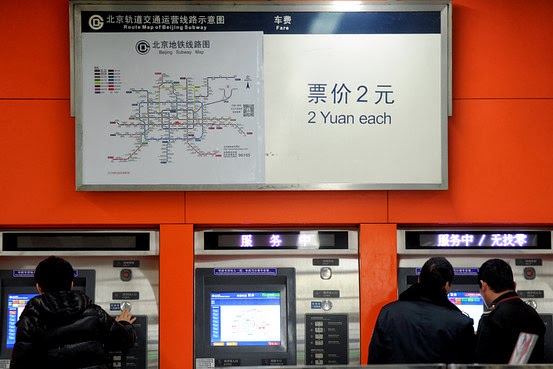
Currently, passengers pay 2 yuan (33 U.S. cents) per ride on the Beijing subway, regardless of destination. But amid a crushing flow of passengers, particularly during rush hour, some are suggesting the city move to a distance-based fare.

The Beijing subway, which was built in the 1960s but only opened to the public in 1971, is the world’s longest, covering 456 kilometers (283 miles). Four new subway lines were recently added to bring the total to 17. But despite additional lines and stops, the fare for a subway ride in the capital has remained at 2 yuan since 2007.

The capital is looking to boost revenue after a statement from the environmental commission said earlier this month that the government’s cost to subsidize public transit is growing. The city’s public transportation bill could rise to as much as 18 billion yuan this year, up from 12.8 billion yuan in 2010, according to China Daily, with as many as 10 million passengers climbing on board daily.

Many other Chinese cities, including both Shanghai and Hong Kong, use a distance-based fare system for their subways, but Beijing has maintained its cheap tickets in part to encourage the use of public transportation in a city already plagued by pollution exacerbated by increasing private car use.

City legislator Ning Bin suggested Beijing charge passengers according to trip length, with a price cap of around 8-10 yuan, according to China Daily.

The idea of raising fares largely met with scorn on China’s Twitter-like Sina Weibo microblogging service, where some users complained they were already dealing with inflation in other areas of their lives.

“Subways are basically a service provided to the common people. Why raise the price? Everything is going up except regular people’s wages,” one Weibo user wrote in a sentiment repeated widely on the site.

Users from other cities dismissed the complaints of Beijing residents, saying the capital had enjoyed low prices for long enough.

“One-way trips in Shanghai usually cost five. If Beijing doesn’t go up, how will that make Shanghai feel?” wrote one microblogger.

Source: Wall Street Journal  by china realtime

Wednesday, 16 December 2015

Snowfall blankets Beijing


Snowfall blankets Beijing December 14, 2012 (Source: Xinhua)

Sunset view at Tamsui District of Xinbei, Taiwan


Photos taken December 14, 2012 shows sunset views at Tamsui District, Xinbei City, Taiwan. (Xinhua)