Welcome

Sunday, 28 September 2014

Luxurious new Boeing 777 delivered to China Eastern

(China Daily) China Eastern Airlines has taken delivery of its first Boeing 777-300ER. The new airplane is the first of 20 that China Eastern has on order.

"We are delighted to introduce our first 777-300ER in China Eastern's new look in celebration of the 10th anniversary of the 777-300ER program," said Liu Shaoyong, Chairman of China Eastern Airlines. "

The delivery not only marks a milestone in the long-standing business relationship between China Eastern and Boeing, but also signals the modernization of our world-class fleet and the enhancement of the competitiveness of our trans-Pacific routes."

China Eastern will operate 777-300ERs on routes between China and North America, which will be a major market for China Eastern over the next three years. The carrier plans to open new routes to North America and also boost frequencies on existing routes from Shanghai to Los Angeles, New 
York, San Francisco, Vancouver and Toronto.

Starting in November, the carrier will deploy its first 777-300ER on services to Los Angeles and New York.

"We are honored to play an integral role in China Eastern's growing success as a leading global airline," said Ray Conner, president and CEO of Boeing Commercial Airplanes. "The 777-300ER is a perfect fit for China Eastern's long-haul fleet and we are pleased to celebrate this milestone delivery together."

Source: China Daily

Saturday, 27 September 2014

China Southern Airlines announces 4th US route

(Xinhua) China Southern Airlines, the country's largest airline in fleet size, is scheduled to begin flying a new route in mid-December from Guangzhou to San Francisco with a stopover in Wuhan.

It will be the fourth service operated by the airline between Guangzhou in south China's Guangdong Province and North America.

There will be three round-trip flights on the route each week, under the flight numbers CZ659 and CZ660. The flights will be undertaken by Boeing 787 Dreamliner, the company said on Friday.

China Southern already flies Guangzhou-Los Angeles, Guangzhou-New York, and Guangzhou-Vancouver.

Source: xinhua via china daily

Friday, 26 September 2014

Explore China's World Heritage Site: Zhangjiajie


Located in northwestern Hunan province, the main draw of Zhangjiajie is the Wulingyuan Scenic Area, which was named a UNESCO World Heritage Site in 1992. Other popular spots in the Zhangjiajie National Forest Park include the Suoxi Valley, Tianzi Mountain and Baofeng Lake.

The wildlife in the national forest park is another main draws. Giant salamanders, rhesus monkeys and golden pheasants are among the creatures visitors might stumble upon during a trek through the photogenic Golden Whip Brook.

Avid hikers can explore mountains, caves and forests, while paved paths cutting through the scenic areas offer a less challenging adventure. Visitors also have the option of taking a glass elevator to the top of one of the peaks.

Source: By Zheng Xin (China Daily)

Thursday, 25 September 2014

China set to face US$100bn tourism deficit

(Xinhua) China is set to see its tourism deficit exceed US$100 billion this year as Chinese traveling overseas spend much more than foreign visitors back home, according to a report by the China Tourism Academy (CTA).

"A tourism deficit greater than US$100 billion is a sure thing this year," said CTA president Dai Bin, citing explosive growth in outbound tourists and a lackluster inbound tourism market.

About 116 million Chinese are expected to travel and spend US$155 billion overseas in 2014, up 20% from a year ago, Dai said.

China has become the world's main source of international tourists in recent years, as a richer middle class seeks more exotic experiences overseas, said the report, released on Monday.

The expected net tourism deficit reflects the increasing purchasing power of Chinese abroad, as they tend to open their wallets generously in European cities such as Paris and London to buy luxury goods from branded bags to expensive wrist watches.

Last year, per capita spending by Chinese traveling overseas was almost three times the amount foreign visitors spent in China, according to Fan Zhiyong, an associate professor under the School of Economics with the Renmin University.

Chinese tourists made a total of 98.2 million trips overseas last year, climbing 18% from a year earlier, according to the China National Tourism Administration.

For the first half of 2014, the administration estimated that Chinese spent more than US$70 billion on their overseas trips during the period, up 20.7% year on year.

As Chinese spend more time and money overseas, competition to attract them is intensifying among foreign countries.

Currently, Chinese can travel to 151 countries for tourism purposes, with Senegal becoming the latest destination under a memorandum of understanding between the two countries this month.

India is also preparing to launch a tourism promotion campaign in Chinese media in the coming months, while introducing audio recordings in Mandarin at popular Indian monuments.

China first recorded a tourism deficit in 2008, when the global financial crisis greatly discouraged foreign spending in the country while a stronger yuan encouraged tourist outflow.

Zhao Xijun, vice dean of the School of Finance and Economics under Renmin University, said the tourism deficit could help internationalize the Chinese renminbi currency as the yuan is converted and used internationally by a growing number of tourists.

For example, the most-visited overseas regions for Chinese, such as Southeast Asian nations, Australia and the Republic of Korea, as well as Taiwan, Hong Kong and Macao, have seen renminbi settlement business boom in recent years.

The internationalization of the yuan and Chinese cross-border consumption support each other, Zhao said,

The tourism deficit will offset a huge part of the trade surplus China accumulated through its merchandise trade.

The country posted a total trade surplus of US$200 billion in the first eight months of 2014, an increase of 30.3% from a year earlier, according to customs data.

Source: xinhua via want china times

Monday, 22 September 2014

Moon Crescent Spring in Dunhuang


Moon Crescent Spring, a unique tourist attraction in the desert of Dunhuang, Gansu Province.

About over 100 meters long and 25 meters wide, the Crescent Moon Spring is surrounded by the Mingsha Mountain.

Source: china.org

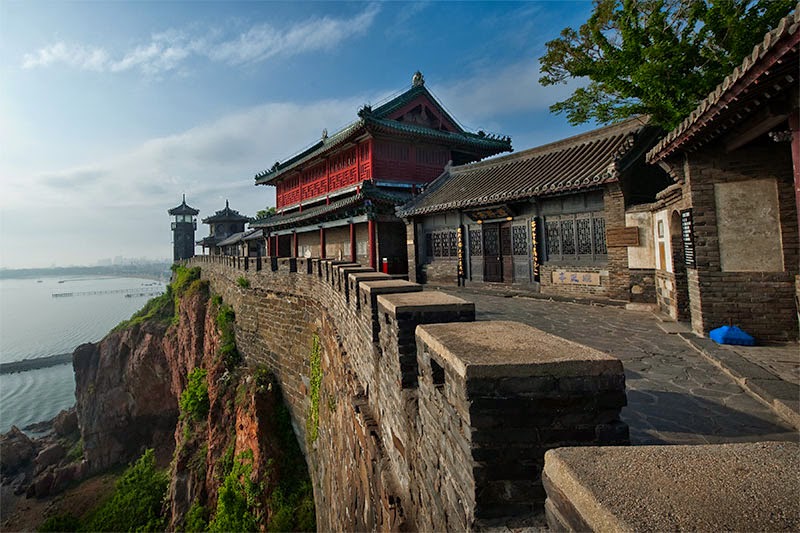
Penglai: a fairyland in the east


The beautiful scenery in Penglai, a popular tourist destination in Shandong Province.


Source: china.org

Saturday, 20 September 2014

The Ancient City of Zhaohua


Set in a stunning natural location, Zhaohua Ancient City is one of the key towns in the history of the Three Kingdoms in China (around 200 AD)


The Jiameng Memorial Archway in Zhaohua Ancient City. The city was also known as Jiameng Pass. Liu Bei, emperor of Shu, set up a camp in the city to conquer Chengdu

The Temple of Duke Jing in Zhaohua Ancient City, one of the key ancient towns in the history of the Three Kingdoms in China (around 200 AD)

The Longmen Academy, built during the Qing Dynasty, is the finest imperial building in Zhaohua Ancient City

Zhaohua Ancient City is one of the better-preserved ancient towns in China. Situated close to Guangyuan City in Sichuan Province, it is a convenient site to check out for those visiting the ancient Jianmen Shu Road.

In the reconstructed city, dozens of antique-style wooden shops offer a rich variety of local souvenirs and snacks. There are a number of preserved buildings that take you back to imperial times, including the local magistrate’s building, the site of the ancient local government.

Strolling through the town, visitors will discover more surprises. In the middle of the town there is the imperial examination hall, with guards in vintage costumes standing outside. Those who wanted to go in to take the civil service examinations had to provide a guarantor to stamp their seal, and there were rooms inside to punish those who were caught cheating!

The highlight of Zhaohua Ancient City is, without a doubt, the riding and jousting performances. An expansive stadium stands right outside the town in a stunning natural location, with steep hills and greenery on all four sides. The riders, dressed as historical warriors, speed around the stadium fighting each other with long lances. Sand flies up into the air and the crowd cheers as the riders are knocked off-balance or thrown onto the ground.

Zhaohua Ancient City, with its historical charm, is an essential destination for anybody who loves history and wants to experience ancient Sichuan culture firsthand.

Source: china.org by Chris Parker