Welcome

Showing posts with label Shandong Province. Show all posts

Friday, 11 December 2015

Qufu, the hometown of Confucius


Qufu, the hometown of Confucius, contains numerous well-preserved historical architectural complexes which are said to represent the "peak of oriental culture". It is home to the Confucian Cemetery which occupies more than 200 hectares and has served as the family graveyard of Confucius and his descendants for more than 2,300 years. In 1994, the Confucian Cemetery, along with the city's two other most famous cultural sites, the Confucius Temple and the Kong Family Mansion were together listed as a UNESCO World Heritage Site


Source: CRI

Monday, 23 November 2015

Tai'erzhuang ancient city in Zaozhuang


File photo taken on Oct. 10, 2012 shows the scenery of Tai'erzhuang ancient city in Zaozhuang, Shandong Province. Tai'erzhuang ancient city was approved to be the national 5A-level tourist area on Nov. 22, 2012. (Xinhua/Gao Qimin)

Monday, 16 November 2015

Beautiful scenery of Daming Lake in Jinan


Photo taken on Nov 14, 2012 shows the scenery of Daming Lake, a scenic spot in Jinan, Shandong province. [Photo/Xinhua]

Saturday, 8 August 2015

Toasting Tsingtao in Qingdao: China's beach-lined beer city


The city is called Qingdao. Its beer is called Tsingtao. And here are seven reasons why you should enjoy both this month.

Probably the most-frequently mispronounced Chinese city in English, Qingdao was China's default beach resort before Hainan started making waves two decades ago.

But Qingdao -- which was briefly a German colony at the turn of the 20th century -- has one thing Hainan can’t offer: beer, good beer, barrel upon barrel of it.

With the opening of Qingdao International Beer Festival (August 11-26), this is the season to enjoy both Qingdao and Tsingtao.

We sought out the best of “China’s Munich.”

1. Drinking frenzy at Qingdao International Beer Festival


The 16-day festival is the closest thing to Oktoberfest in China. During last year's beer bacchanal, some 3.8 million visitors downed nearly 1.1 million liters of the amber nectar.

Brews from Japan, Czech Republic, the United States, Germany and China are poured into pitchers, mugs, steins and even plastic bags.

Beer tents compete to lure patrons with blaring music and gyrating performers. Semi-sober drinkers can sing karaoke on the public stage for a modest fee.

This year’s Qingdao International Beer Festival takes place in the Laoshan District in eastern Qingdao.

The square can get crowded at night and hot during the day, so pacing alcohol intake and timing your visit are keys to enjoying this annual highlight.

The 22nd Qingdao International Beer Festival (青岛啤酒节), Qingdao Beer Passion Square, Shiji Square, Laoshan District, Qingdao, Shandong 山东省青岛市崂山区世纪广场青岛啤酒激情广场, 9 a.m.-10:30 p.m., August 11-26.

Ticketing hotline: +86 133 0532 1665, www.qdbeer.cn. Admission: RMB 10 (9 a.m.-3 p.m.), RMB 20 (3 p.m.-10:30 p.m.)

2. Swimming at No. 2 Bathing Beach


This beach was once reserved exclusively for top officials of the Communist Party of China.

Mao Zedong came to Qingdao in July 1957 with his wife Jiang Qing, their two children and his closest political advisors for a conference with provincial and municipal Party secretaries.

Meetings were held on No. 2 Bathing Beach in straw huts, where the future of the country and the Party were discussed.

Mao apparently liked Qingdao a lot -- he swam at this very spot five times in 1957.

Mao’s swim in the ocean set a precedent for subsequent Party leaders, including Deng Xiaoping, who visited in July 1979.

"What's unique about Qingdao is that the beaches are not only places of leisure but they also have political significance in Chinese history ..." says Qingdao-based American Edward Barrington, who is a Chinese political enthusiast.

"No. 2 Beach has ties to Mao and Deng ... even Chiang Kai-shek lived near there for a while."
The previously restricted beach is now open to the public.

Qingdao No. 2 Bathing Beach (青岛第二海水浴场) 6 ShanhaiguanLu, Shinan District, Qingdao, Shandong 山东省青岛市市南区山海关路6号, +86 532 6657 7309

3. Walking along Daxue Lu


Daxue Lu in Qingdao is like the former French Concession in Shanghai -- both are the city’s most walkable area with a brew of colonial and Chinese buildings.

"When I first came to Qingdao [in 2011], I fell in love with Daxue Lu," says Peng Jingjing, a Chinese restaurateur who originally comes from Wuhan. "It really is one of the most beautiful streets in China."
The 1,300-meter-long street is named for its location adjacent to Qingdao's oldest college, Ocean University of China (formerly Qingdao University).

Daxue Lu, as well as Qingdao’s old town around it, has witnessed a certain gentrification in the past few years.

It’s now a tree-lined neighborhood with a craft brewery, numerous cafés, Qingdao Municipal Art Museum and historical period architecture, including the former residence of Chinese author Lao She (老舍), who wrote the classic novel “Rickshaw Boy.”

Overlooking Daxue Lu, Signal Hill affords scenic views over the old town and Jiaozhou Bay.

Qingdao Municipal Art Museum (青岛美术馆), 7 Daxue Lu, Shinan District, Qingdao, Shandong 山东省青岛市市南区山大学路7号, +86 532 8288 8886, 9 a.m.-4:30 p.m., free entry

Strong Ale Works Craft Brewery, 12 Daxue Lu, Shinan District, Qingdao, Shandong 山东省青岛市市南区山大学路12号 +86 136 0896 4700, reservation required for brewery tour and tasting

4. Exploring German architecture around Zhan Qiao Pier


Zhan Qiao Pier area is ground zero for Qingdao’s German architecture. The pier itself became famous as part of the Tsingtao Beer logo.

The neighborhood includes a concentration of Germanic buildings that once housed the British and American consulate buildings and German government offices.

The 101-year-old Zhan Qiao Prince Hotel, designed by the German architect Curt Rothkegel, is one of the remaining original structures on the coastal road.

It is said to have been named after German Emperor William II’s brother Prince Henry, who stayed at this hotel several times during Germany’s colonization (1898-1914).

Kiautschou Coffee in the lobby is operated and frequented by a group of nostalgic Qingdao residents, who are passionate about the preservation of the old buildings.

"I've lived in the old neighborhoods of Qingdao for nine years and Kiautschou Coffee is definitely a good place to learn more about the German past of the city," says John Herrington, an English teacher from the United States.

The coffee shop has a collection of historical publications, illustrations, and photographs of old Qingdao.

Zhan Qiao Prince Hotel (亨利王子饭店) 31 Taiping Lu, Shinan District, Qingdao, Shandong 山东省青岛市市南区太平路31号, +86 532 8288 8666, nightly rate: from RMB 478

5. 'Getting hammered' at Tsingtao Brewery Museum


No. 56 Dengzhou Lu appears as the company address on every bottle of Tsingtao beer.

It is the site of the original Tsingtao Brewery, founded in 1903 by an Anglo-German brewery company. The compound continues to function as a factory for Tsingtao beer as well as a beer museum.

The 6,000-square-meter exhibition area includes displays of old promotional materials and bottle designs from the history of China's best-known beer.

There's even a “drunk room” to let visitors experience the feeling of “being hammered” (without the actual drinking).

The specially designed room simulates the different effects of alcohol, such as loss of balance.

Visitors can get a glass of beer -- free but small -- at the end of their museum tour.

Tsingtao Brewery Museum (青岛啤酒博物馆), 56 Dengzhou Lu, Shibei District, Qingdao, Shandong 山东省青岛市市北区登州路56号, +86 532 83833437, 8 a.m.-6 p.m., RMB 50

6. Sailing on the Yellow Sea


Qingdao was branded China's Sailing Capital after being named the host of the 2008 Olympic Sailing Regatta.

Qingdao’s Olympic Sailing Museum showcases seafaring Qingdaonese’s passion for the sport (and the Beijing Olympics) with various exhibits like the sailboard, with which the Chinese athletes won the Beijing Olympic gold, and a sailing simulator.

Real go-getters can voyage with Sinan Sailing Club in Qingdao Olympic Sailing Center or charter boats at the Yinhai Marina for recreational fishing and day trips on the Yellow Sea.

Qingdao Olympic Sailing Center (青岛奥林匹克帆船中心),121 Aomen Lu, Shinan District, Qingdao, Shandong 山东省青岛市市南区澳门路121号,
Sinan Sailing Club (司南帆船俱乐部), 1 Jinwan Road, North Slipway, Qingdao Olympic Sailing Center, Shinan District, Qingdao, Shandong 山东省青岛市市南区金湾路1号青岛奥帆基地北下水坡道, +86 152 8898 7909
Qingdao Yinhai Yacht Club and Marina (青岛银海国际游艇俱乐部), 30 Donghai Road, Shinan District, Qingdao, Shandong (山东省青岛市市南区东海中路30号, +86 532 8588 0000

7. Enjoying the weather


Qingdao's proximity to the water and a relatively mild climate are the main reasons for its renown as a resort.

Low temperatures and breezy nights lure visitors from other Chinese provinces and cities where it can be five to 10 degrees hotter in July and August. Average temperature for Qingdao’s summer is 25 C.

Also, the sandy beaches are right in town. This distinguishes Qingdao from another northern Chinese coastal city Dalian, where the coast is rocky and further from the city center.

A city of eight million, Qingdao was built right on the sea, so walking around downtown means one is never far from the ocean.

Getting there: Roughly midway between Beijing and Shanghai, Qingdao International Airport is linked to 12 international destinations -- including Tokyo, Seoul and Frankfurt -- and 82 cities in China. The airport is approximately 23 kilometers north of the city center.

Source: CNN Go

Tuesday, 14 July 2015

Cheers to Qingdao

If you know anything about beer, you will have heard of Qingdao. The city on the shores of the Yellow Sea gives its name to China's best-selling international lager Tsingtao, the original brewery being set up in 1903, shortly after what was then a fishing village on the Shandong Peninsula became a German naval base and concession.

Now one of China's major ports with a population of about 8 million, Qingdao is known for much more than beer. It boasts the largest beach in Asia and the longest sea bridge in the world, but more importantly for visitors and residents alike, it is reputed to be one of the nicest places to live in China.

The German influence is still apparent in the architecture of the buildings in the old town, several of which now house public institutions. And the city still hosts an annual international beer festival. This year's begins on Aug 11.

Last year, the city recorded more than 50 million visitors, many of them staying in the 153 star-rated hotels. These are some of the highlights that may have made their trip memorable:

1. The Badaguan Scenic Area

This is the old part of town, built during the German concession and lying in the eastern part of the city in Shinan district. Badaguan means "eight passes" in Chinese, with the avenues named after mountain passes that intersect the Great Wall. Two more roads were added in the 1930s.

Called the "streets of flowers", the area is well known for its garden villas and Western-styled buildings.

The flowers are always out, no matter what season, making Badaguan perfect for strolling or driving around and sightseeing at any time.

2. No 1 Bathing Beach

Recognized as the largest sandy beach in Asia, and the best in Qingdao, the No 1 Bathing Beach is appreciated for its soft sand and clear waters.

Located by Huiquan Bay and surrounded by green mountains, the beach provides all the services that visitors and holidaymakers could wish for, from lockers to restaurants.

During the hottest months from July to September, many arrive from nearby regions and provinces, but No 1 is big enough never to feel overcrowded. There are rooms for 200,000 comfortably every summer.

Lining the beach are many changing huts and chalets of innovative designs and various styles. Some are round, some are square, and some have towers, all lending to create a fairy-tale atmosphere.

If you are curious about the quality of the maritime environment, it should be noted that Qingdao hosted the sailing events for the 2008 Beijing Olympics.

3. Castles

Many of Qingdao's splendid old buildings can be seen in Badaguan. Ones to look out for include the Granite Castle, which according to the sign out front, was the villa of Russian aristocrats. It was built in 1931 but now serves as a very popular backdrop for wedding photography.

Not far away on Signal Hill is the four-story Qingdao Guest House, built in 1908 in the style of a German schloss and now a museum featuring its antique furnishings and ornaments. Originally the German governor's home, it was later used by Mao Zedong and hosted several other political leaders.

Elsewhere in the old town are the former Bismarck Barracks, now a fisheries college, and the Qingdao Art Gallery and Museum building, which used to be the headquarters of the Red Swastika Society.

3. Qingdao Beer Museum

Qingdao Beer Museum is located in Dengzhou Road, within the Tsingtao Brewery. The pavilion takes full advantage of the century-old German buildings to demonstrate the brewing technology and production of its famous brand. With an investment of about 40 million yuan ($6.28 million, 5.11 euros), it is also considered the only beer museum in China.

There are three areas to the museum. The first deals with the history and culture of Tsingtao beer. In the second, there is an exhibition of the old plant and equipment, placed to contrast with the modern production line and brewing methods. There are also reproductions of traditional workshops.

The third section is a multipurpose entertainment area for up to 200 visitors. Visitors can taste various kinds of Tsingtao beer and buy souvenirs.

4. Qingdao International Beer Festival

The first Qingdao International Beer Festival was held in 1991 and since then, the festival has become a major event for the coastal city. The festival begins on the second Saturday of August and lasts for 16 days.

This year's opens on Aug 11 at Century Square (renamed Tsingtao Beer Passion Square for the event) and will feature activities, including competitions, exhibitions, parties and parades. Beer fans can enjoy more than 200 varieties of beer from 20 brands and 13 countries.

The 21st Qingdao International Beer Festival last year attracted 3.8 million visitors who altogether consumed 1,100 tons of beer.

Eating and drinking

For first-time visitors, Pichaiyuan is the snack area where they can taste all kinds of traditional Qingdao snacks such as fried dumplings, tofu jelly and shrimp wontons. Situated in Zhongshan Road, Shinan district, the courtyard has about 40 restaurants.

Another street for food is the Qingdao Beer Street, which lies in Dengzhou Road of Shibei district. There are more than 50 bars and eateries on the street. You can't miss it - the road's painted green.

The popular bar area, Zhonglian Creative Square, lies in Nanjing Road. There is a group of about 10 bars sited on the tops of buildings and connected by bridges and clear-glass lifts.

There are quiet bars to chat with friends and also clubs where the music and dancing never stop.

Friday, 12 June 2015

Legacy of Jinan's springs

Jinan's old-timers fondly recall stories from their childhood, when one or the other of the city's 72-odd springs was central to their lives. For some, they still are.

Like 70-year-old Sun Chao-wen, who religiously collects water every day from the Black Tiger Spring near his home. "My mother would use spring water to cook and I am still using the same to make tea," he says.

He has quite a range of personal anecdotes about growing up in a terrain dotted with springs, from plunging into Black Tiger Spring as a kid to eating watermelons with friends on lazy summer afternoons. "I think the springs are the most precious memory of my childhood."

Ditto Wang Fenghua, 59, who cannot imagine what Jinan might be like if it weren't for the springs.

She is especially excited by the fact that the waters from these springs comes with distinctive tastes. "It's not the same everywhere - the water is softer and sweeter in a few of these."

She is also a little concerned that as more people wake up to the health-affirming properties of the spring waters, the springs are being exposed to greater hazards.

"The springs in Jinan are the most precious thing we have, it is our obligation to protect them," she says.

The local government has had a department dedicated to that task since the 1970s. "The challenge," says its director Lei Xue-duan, "is to be able to protect the springs from coming into harm even as the city goes through phases of construction and rapid economic development."

For instance, constructing a subway network is going to be a really tricky issue.

In 2003, a law prohibiting industrial units from harnessing spring water was passed, which has been more or less complied with, says Lei.

Jinan has about 645 springs, including the 72 that are best-known.

"We're trying to get Jinan the status of a world heritage site, as it is a natural, intangible heritage, promote the city's culture and lifestyle around springs," Lei says. "We will host a Jinan Springs Culture Festival next year."

The optimism is palpable. "Tourist interest in the springs is steadily rising," he reveals. "Previously Qufu and Mount Tai were the obvious tourist destinations in Shandong, but now people are coming to Jinan just to see the springs."

Source: By Zhao Ruixue in Jinan (China Daily)

Pleasures of Daming Lake In Jinan

There is a face of Jinan that's dramatically different from the intense weave of high-rises, multi-tiered flyovers and glitzy storefronts that meets the eye at first. The flip side to this world of vehicles whizzing past and the hammering and scaffolding signifying continuous construction activity is not difficult to locate. The moat that once ran round the old city is still the focal area if you're looking for some of Jinan's most iconic landscapes - where the city's elderly and the very young like to gather.

It's a retreat for those who want to renew their bonds with nature, even as life speeds past them in one of China's fastest-growing manufacturing and technological hubs.

Our journey began at the south gate of Baotu Spring Park, where the most spectacular cluster from among Jinan's famed 72 springs might be found.

The springs in Jinan are a way of life here, especially for seasoned Jinan natives who come here early to chat or sing with pals.

They may take in a Shandong opera performance or two even as they keep an eye on their pint-sized grandchildren, cavorting merrily in the park, looking out for the lone seal in one of the ponds while shoals of goldfish swarm in the rest.

Nature has been generous with its gifts to China, and the amazing natural phenomena in this land have become a reference point for China's writers and artists. Baotu Spring Park is no exception.

For instance, a couplet written by Yuan Dynasty poet and calligrapher Zhao Mengfu (1254-1322) - "Mount Hua cannot be overcast by the clouds and fog/ The waves and the billows reach the Daming Lake" - appears at the

Luoyuantang Temple, a two-tiered pagoda-roofed pavilion overlooking the water mass created by the three major springs in this park.

The springs, despite Jinan's low water levels, keep gushing forth and sending out ripples in concentric circles - the temperature a constant at 18 C all the year round - affirming the perennial renewal of the natural cycle.

Cangyuan Garden used to be the study of Ming Dynasty poet Li Panlong (1514-1570), and is still referred to by his nickname. It has since been turned into a gallery exhibiting the works of the master landscape painter Wang Xuetao (1903-1982).

Calligrapher and painter Guan Yousheng had carved the words "Shuyu Spring" on the low stone wall with handrails girdling the spring waters in the north, in 1956.

It was his homage to the Song Dynasty poet Li Qing-zhao (1084-1151) - who would, so the story goes, use the clear waters of the spring as a mirror while combing her lustrous tresses.

Easily the most feted among the poets and artists memorialized in Baotu Spring Park, Li has an entire pavilion dedicated to her, plus a series of tableaux comprising life-size wax models depicting her illustrious life.

Born into a noble family, Li was a child prodigy of sorts. Her artistic sensibilities were perfectly matched with that of the writer and statesman Zhao Mingcheng.

Duty kept Zhao away from home for long spells, inspiring Li to write some of her finest poems of love and longing, even as she watched her unkempt hair grow ruddier still, reflected in the spring waters.

It's fun stepping into the cheerful red and yellow covered boats from the north end of Baotu Spring Park.

The journey to Daming Lake, a water mass created by the convergence of hundreds of springs and sprawled out over 460,000 sq km, starts with adjusting the water level of the moat through manipulating the sluice gates.

As the boat goes down by about 3 meters, the sharp drop might be temporarily unsettling.

But soon enough the sight of the lush greenery on either side of the narrow canal, tiny waterfalls jumping into the stream and images of men fishing and children running around on the banks more than makes up for the initial jolt.

Sailing underneath an arched bridge, we reach the waters of the lake, almost without warning.

The green waters turn a colorless gray, lapping heavily against the 16-seater boat, which now feels really tiny. Far away in the horizon, a boundary of greenery cordons off the slew of high-rises.

We pass by a neat little island with trimmed hedges and rows and rows of weeping willows.

It's a part of the Daming Lake Park - where no one is allowed to go, except the men who have been keeping the garden and the pagoda-roofed pavilion on it all spic-and-span.

The boat drops us at the north-east gate of the lake. There are at least two noted temples - the Ming Dynasty (1368-1644) courtyard-style Tiexuan Temple and the Taoist Beiji Temple, originally built in the Yuan Dynasty (1271-1368) - across the road.

And then there are the art galleries, giant murals in Tianqiao Square, posh hotels with life-size sculptures lined up in the garden, a small geological museum and another one that used to be the Kuomintang headquarters around 1928, when the Kuomintang soldiers clashed with Japanese troops in the battle for Jinan.

Those running the roadside bookstores seem to be tipped, somewhat, in favor of the Kuomintang leader Chiang Kai-shek, whose army-gear clad figure appears on several prominent displayed titles.

But we prefer to walk back along the lake's north and north-western promenade rather than pop into any of these spots of tourist interest, taking our queue from the people, sitting around in lake-side benches or strolling leisurely, as they sip from their bottles of iced tea, or decide to get photographed in garish period costumes borrowed from a kiosk on a whim, giving in to a breezy afternoon of care-free indolence.

Source: By Chitralekha Basu and Zhao Ruixue (China Daily)

Thursday, 14 May 2015

Confucius thought still flowering

Source: By Chitralekha Basu (China Daily)

At the Confucius Temple complex in Qufu, Chitralekha Basu found herself surrounded by more than just historical charm.

We are in Confucius (551-479 BC) country, walking around the Confucius Temple complex dedicated to the man, whose influence over Chinese thought and lifestyle practices has been sustained over the last 2,500 years.

Yet this massive monument to wisdom and scholarship in Qufu, Shandong province -sprawled out over 16,000 square meters and second in terms of scale only to the Forbidden City in Beijing whose model it emulates - moves me not so much because of what it is, but rather what it grows.

Tall coniferous trees line up on both sides of the approach road to the fortress-like entrance, leading to Linxing Gate. Long and thin stems of weeping willows, glittering under the mid-day sun like tinsel, bend over the moat around the wall to touch the rippling waters beneath.

Inside, it is the cypresses lording it over. Their serrated trunks spread out and twist in impossible formations, growing bulbous knobs in odd places. Sometimes, the trees slant dangerously, kowtowing to the forces of gravity.

The most legendary among the trees in this compound, of course, does not exist any more. But a red-pillared, yellow-tiled pavilion marks the spot where it once stood.

The apricot, under whose shady boughs the great seer would discuss and interpret some of the ancient classical Chinese texts - The Book of History, The Book of Rites, The Book of Odes, The Book of Music and The Book of Changes - with some of his disciples is memorialized with due reverence. This was after Confucius had returned to the State of Lu after a long-drawn, hazardous journey across China but did not wish to be re-instated as a high-ranking official, preferring a quieter and more contemplative life instead.

In Confucius' turf, the mythology around trees seems to build and prosper even independently of the great philosopher, one of whose themes was about man's communion with nature. For instance, there's a cypress under which an elderly Emperor Qianlong (1711-1799) of the Qing Dynasty (1644-1911) - who visited the temple eight times as his daughter had married into the Kong family - was supposed to have rested. Legend has it that the bark of the tree crinkled and grew warts to resemble dragon hide, resonating with and reinforcing its imperial associations.

There's a juniper tree that is supposed to have been planted by Confucius himself but, as our guide says, it is probably only about 300 years old. Not too far away from the centerpiece in this courtyard, the Hall of Great Perfection - where sacrificial offerings would be made in Confucius' memory in ancient times - a gingko tree from the Song Dynasty (960-1279) and a Chinese scholar tree from the Tang Dynasty (AD 618-907) appear fresh and resplendent in the golden light of a summer afternoon.

There are more leafy surprises in store as we move on to the courtyard of the Kong family residence, where 32 generations of Confucius' descendants lived for 880 years, until the 76th and the 77th in the line fled to Chongqing in 1937, after the outbreak of the War of Resistance against Japanese Aggression (1937-1945). They eventually moved to Taiwan in 1949, coinciding with the defeat of the nationalist Kuomintang and the founding of the People's Republic of China.

Vines twirl up around the four-storied Tower of Refuge, built in the late Qing era as a hideaway at the time of a possible crisis, but never put to use.

The family had reasons to fear for their lives. They were close to the Kuomintang leader Chiang Kai-shek who was invited to attend the wedding of the 76th generation Kong Decheng and his fourth wife in 1936. But the Xi'an Incident happened and Chiang went on the run, eventually captured by his former ally, the Manchurian warlord, Zhang Xueliang.

The high-profile guest never got to attend the wedding, but the bedchamber and the Wedding Hall of Double Happiness, still done up in nuptials-related paraphernalia, remains indelibly linked with a turning point in Chinese history.

In the courtyard, a Chinese scholar tree, its trunk curiously split into five equal parts by lightning, stands like a metaphor of the tensions and dissonance that its last set of residents had seen.
In the backyard of this family home, an intense growth of purple flowers and buttercups, interspersed by wispy dandelions, sprawls out, covering the expanse up to the boundary wall. The foot-high carpet of shrubbery is punctuated by maple trees, resplendent in myriad shades of red at the height of spring.

The way to the Forest of Steles - where Confucius' descendants down to the 78th generation lie in eternal rest - is through a paved avenue, flanked on either side by cypresses and pines that are at least a thousand years old. The cemetery - covering an astounding 17 sq km area - looks like a never-ending sea of purple flowers, its bounty overwhelming the several thousand-odd steles, dwarfed by the unregulated growth.

There used to be 100,000 of these at one time, put up since the Han Dynasty (206 BC-AD 220), but only about 3,600 remain, the rest having been vandalized by the Red Guards during the "cultural revolution" (1966-76) or fallen to natural decay.

Tender green creepers spiral up around ancient oak tree (jixiang in Chinese, also meaning excellent or auspicious) trunks. Many of these were supposedly planted by Confucius' devout student Zi Gong in his teacher's memory. Nature's constant renewal is in evidence as fresh, mint green leaves sprout from the earth under which lie two millennia of the dead.

The tombstones dedicated to Confucius were put up much later, by a member of the 51st generation of the Kong family, and another one in the recent past. These stand on the spot of Imperial sacrifices made in honor of the philosopher-statesman, as Confucius' grave was never located.

There is possibly a bit of poetic justice in the fact that it remains untraceable. Confucius had talked about heaven and humanity becoming one, imagined humankind and the natural world in perfect harmony.

Standing amid the riot of purple flowers, inundating the ornamental tombstones, blurring the line separating the flowers and pale blue horizon, one might get a sense of what he was talking about.

Saturday, 25 April 2015

Qufu, the hometown of Confucius

Qufu is famed for its association with confucius but most visitors overlook three peaks nearby that hold natural beauty, legends and strong ties to philosopher

For visitors to Qufu, the hometown of Confucius, a trip to the Three Kongs, the temple, the mansion and cemetery associated with the great philosopher, is almost obligatory.

But what most travelers overlook are three equally impressive mountains and hills that surround the city and off er respite from the tourist hordes.

The three mountains and hills of Qufu are worth a visit for their natural beauty alone, but they also hold historical and cultural treasures that make the climb a must.

1. Nishan Hill

While Qufu is famed as the city of Confucius, it was in fact on Nishan Hill that the man whose ideas have shaped China is said to have been born, in a three-meter deep cave called Kunling at the foot of the hill.

According to legend the baby Confucius was abandoned shortly after birth because his mother thought he was ugly, but was rescued by a tiger and an eagle, which later made the mother take him back.

Higher than Kunling Cave and to the west is River Watching Pavilion, from where Confucius is supposed to have watched the river fl owing and gasped at how rapidly earthly life changes.

The hill is also home to a Confucian temple that houses an old lecture hall used today solely for venerating the philosopher.

Behind the lecture hall is an earthen hall, which in ancient China was a common construction used for honoring the God of the Earth. Here, Confucius is said the have received help from the God of the Earth on his way to becoming a saint.

The educational center Nishan Academy on the hill was a site of scholarly discussion for centuries and still serves a similar purpose with school visits on occasions.

2. Nine Fairy Mountain

Like many picturesque mountains across China, Nine Fairy Mountain is associated with legend.

The story goes that the nine fairy maidens of the Queen Mother of the West escaped to the mountain while the Queen Mother was happily drunk during her birthday party. Angry at their departure, the Queen Mother then transformed the fairy maidens into nine peaks.

Today the mountain is dotted with brooks, fruit trees and agricultural land, and is a source of many medicinal herbs, no doubt having grown with the help of the nine fairies.

In ancient China, the mountain was home to many religious groups that have left their mark in the form of temples, including Confucianists, Daoists and Buddhists.

During the Qing Dynasty (1644-1911) an annual temple fair was started on the mountain in spring, drawing hundreds of peddlers, incense burners and performers. The temple fair later came to a halt during times of social unrest, but was restored by the local government in the 1990s along with several historical sites.

At the highest reaches of the mountain is the Bixia Ancestral Temple. Bixia was, according to legend, a fairy who did many kind deeds and whom local people called "grandma". A statue of Bixia stands in the temple's main hall.

Behind the temple are three stones said to emanate coolness even during the hottest summer day, making this a pleasant place to take a break.

On the northeastern section of the mountain is Phoenix Hill. With an elevation of 548 meters it is the tallest peak in Qufu.

Across the mountain it is not uncommon to see fruit laid out in the sun, including pears, dates, peaches and pomegranates. Even at harvest time in late autumn people often do this to satisfy a local liking for dried fruit.

3. Stone Gate Mountain

Stone Gate Mountain has 14 peaks, two of which sit opposite each other, creating the gate shape that gives the mountain its name. The mountain is divided into three main areas: Stone Gate Temple, Peach Dock and Yellow Mountain.

Of the 14 peaks, Shenghan Peak is the tallest at 406 meters. It is also well known for its caves and links with ancient philosophers and poets.

Confucius and his students frequented the mountain and used it as a place to study. The poets Li Bai and Du Fu also toured the mountain together.

More than 90 of the mountain is covered with forest, making its' 6 square kilometers a natural oxygen bar.

Source: China Daily

Monday, 16 March 2015

Amazing scenery in Rizhao, Shandong


Located in the southeast Shandong Province, Rizhao is a coastal port city and enjoys abundant tourism resources. The city boasts a coastline of 100 kilometers, 64 kilometers of which are golden beaches and meet the standard of world first-class bathing beaches. In the last few years, Rizhao has been granted many honorable titles, including China's Outstanding Tourism City, National Model City of Environmental Protection, Environmentally-friendly National Model City, and National Garden City. [Sohu.com]

Wednesday, 15 October 2014

A mountain that scales China's history


During a 3,000-year span, emperors, poets and scholars made pilgrimages to Mount Taishan to pray to the gods, leaving behind hundreds of inscriptions and stone tablets, Zhao Ruixue reports in Tai'an, Shandong province

Tarzan, whose paradise is in the African jungle, might also feel at home on Mount Taishan in Shandong province. Not only does the mountain share the cartoon figure's namesake (Tarzan is translated as Taishan in Chinese) but it is lush with green vegetation that could make for a comfortable environment for the tree-swinger.

Vegetation covers nearly 80 percent of the mountain, which has 989 species of flora, including 462 species of medicinal plants, such as multiflower knotweed, Taishan ginseng and Chinese gromwell, that are indigenous to the region. The mountain also has more than 200 animal species and 122 bird species.

One could only guess if Tarzan would appreciate the temples and stone tablets that dot the mountain. After all, it would be difficult for him to understand them.

Described by UNESCO as "a world-renowned treasure house of history and culture", Mount Taishan is ideal for people who want to learn about Chinese history while enjoying beautiful landscapes.

Named Dong Yue (the sacred mountain of the East), Mount Taishan is located in Tai'an. Jining, Confucius' hometown, lies to the south and Jinan, the provincial capital, to the north.

"Among the mountains of China, Mount Taishan is the most intertwined with Chinese history. 

Cultural interests and natural landscapes are well integrated into the mountain," said Du Xiaofan, a member of UNESCO's Beijing office.

Mount Taishan, with its dense forests and ancient temples, has been the site for imperial pilgrimages for roughly 2,000 years, according to UNESCO, and the artistic masterpieces found throughout the mountain are in perfect harmony with the natural landscape.

Standing 1,545 meters above sea level, the mountain is by no means the tallest in China, but it is among the first to be blessed with the sunrise's golden hues because of its geographical location in East China. It was regarded in ancient times as the closest position to the sky.

Over 3,000 years, Chinese emperors have made pilgrimages to Mount Taishan to pray to the gods. 

Scholars and poets have marveled at the majesty of the mountain and composed poems and prose in honor of it, some inscribing them on the mountain.

Twelve emperors, beginning with Qin Shihuang, the first emperor that unified China in 221 BC, have paid homage in a ritual called "Fengshan Sacrifices" at Mount Taishan, said Lyu Jixiang, a researcher with Taishan's management committee.

"There are more than 2,000 rock inscriptions and stone tablets testifying to visits by emperors and scholars," said Lyu.

Lyu said more than 10,000 poems and works of prose have been found.

Located at the foot of the mountain, the Dai Temple is a must-see. Measuring 405 meters by 236 meters, Dai Temple is the largest and best-preserved structure on Taishan. Built in the Han Dynasty (206 BC-AD 220) as a site at which emperors paid their respects to the gods, the temple was expanded and renovated by rulers of the Tang (AD 618-907) and Song (960-1279) dynasties.

Han Emperor Liu Che (141-86 BC) visited Mount Taishan ten times. It is said the emperor planted 1,000 cypresses at the Dai Temple, thought only five survive today. Two of the five have had their barks stripped but surprisingly some of their branches are still greeting tourists with green leaves.

The Tiankuang Hall, the temple's main structure, houses a giant Taoist mural that is 3.3 meters high and 62 meters long and depicts the god of Taishan Mountain on an inspection tour. The mural details forests, palaces, bridges, riding beasts and 697 people and was painted during the Song Dynasty.

Parts of the mural have been damaged, though it is slated for repairs this year, said Zhao Peng, deputy director of Tai'an Museum.

The Dai Temple is also called "the forest of stone tablets" because it houses more than 300 stone tablets, Zhao said.

At the summit of the mountain is an address made during one of the "Fengshan Sacrifices" rites that was written by Emperor Li Longji (who reigned from AD 712-756) during the Tang Dynasty.

Emperor Li took the rite seriously. He selected 1,000 horses and a massive army and began his journey to the temple from the then capital of Chang'an. Emperor Li carved his address in an entire cliff to show his achievements.

At the summit, you will also see several monuments marking Confucius' visits.

"The Platform for Viewing Lu Kingdom" is where Confucius scanned over the Chinese kingdom and where an upright slab of stone is inscripted with "Confucius finds the world small".

The Azure Cloud Temple at the summit has become a popular place for people to burn incense and pray for their health and happiness. To protect the environment, the management committee for the mountain has prohibited incenses longer than 50 cm.

Statistics from the local tourism administration shows 48.3 million tourists visited the city last year, generating 44.17 billion yuan ($7.08 billion), which accounted for 15.8 percent of Tai'an's GDP.

In recent years, the local government has introduced several projects to enrich its tourism industry. 

Among them are performances to re-enact the "Fengshan Sacrifices" at Fanta Wild Adventure Park.

IF YOU GO

Travel tips

The popular eastern route is dubbed the "Imperial Way" because it was historically favored by emperors. Nearly 7,000 steps snake up the mountain and the route is dotted with sacred spots, carvings and inscriptions by China's famous literati and rulers.

・ From the Red Gate, tourists will encounter such sites as the Middle Heaven's Gate, the Wudafu Pine, the 1,600-step 18 Bends and more than 300 inscribed cliffs.

・ You can also take a tour bus for 30 yuan ($4.80) at Tianwaicun village to Middle Heaven's Gate.

・ From Middle Heaven's Gate, take a cable car to South Heaven's Gate located at the top of the mountain for 80 yuan ($12.80).

・ From the South Heaven's Gate, tourists can hike to Jade Emperor Peak, the summit of the mountain. Southeast of the peak is a stone pagoda named Sun-Watching Peak because it is an ideal spot to watch the sunrise.

・ Tourists can also take the ropeway from Peach Blossom Ravine at the western part of the mountain, which will take you directly to the South Heaven's Gate.

・ The temperature at the summit is usually seven degrees lower than at the foot of the mountain.

How to get there :

・ High-speed trains run from Beijing and Shanghai to Tai'an every couple of hours.

・ A ticket of admission for Mount Taishan is 127 yuan ($20.36) from Feb 1 to Nov 30. It costs 110 yuan ($17.63) from Dec 1 to Jan 31.

Source: By Zhao Ruixue (China Daily)

Monday, 22 September 2014

Penglai: a fairyland in the east


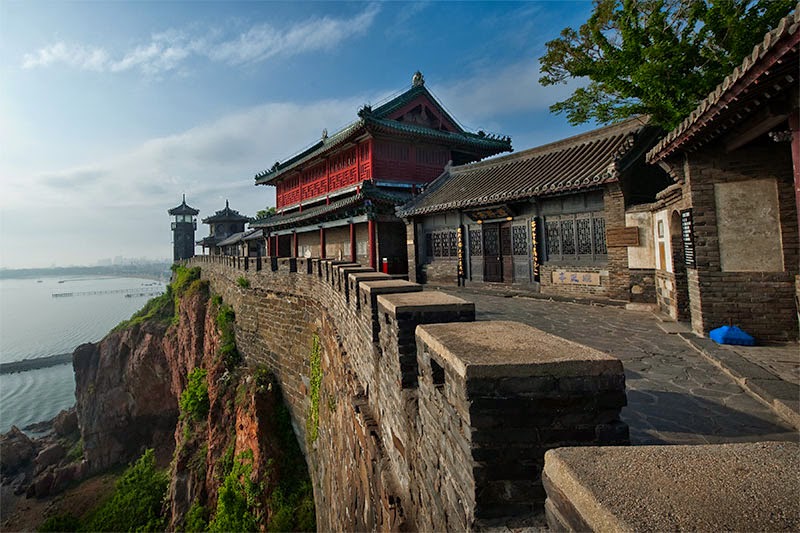
The beautiful scenery in Penglai, a popular tourist destination in Shandong Province.


Source: china.org